


 Alessandro Stesi
Aiuta il progetto Folding@home con la Cyberfero
Folding@home e’ un progetto di calcolo distribuito per simulare la dinamica delle proteine – il processo di piegatura delle proteine e i movimenti delle proteine implicati in una varieta’ di tumori e malattie, tra cui l’Alzheimer, l’Ebola e il COVID-19.
Consentendo alle persone di tutto il mondo di eseguire queste simulazioni sui propri personal computer, il progetto Folding@home mira ad aiutare gli scienziati a comprendere meglio questi processi e identificare nuove opportunità di trattamenti.
Ovviamente, puoi eseguire Folding@home come macchina virtuale anche nel Cloud della Cyberfero. Il client Folding@home è disponibile nei template delle macchine virtuali, quindi tutti gli utenti del Cloud Server possono usarlo per costruire la propria macchina virtuale. Ecco una guida rapida per configurarlo.
1. Costruisci un virtual server utilizzando il template Folding@home
Per iniziare, effettua il deploy di un server virtuale utilizzando questo modello: CentOS 7.7 x64 FoldingHome. Modifica CPU/RAM a tuo piacimento e crea il VS.
Una volta che il Virtual Server (VS) è attivo e in esecuzione, ssh/console su VS e confermare che il servizio fah è in esecuzione:
      [root@folding ~]# /etc/init.d/FAHClient status

      fahclient is running with PID 1268
Modifica config.xml nella directory /etc/fahclient e modificalo per aggiungere la sezione <! – Remote Command Server ->, in cui possiamo dire al client il nostro indirizzo IP remoto. Oppure fai come ho fatto in questo caso e consenti l’accesso da tutti (0.0.0.0/0) ma con una password:
[root@folding ~]# cat /etc/fahclient/config.xml
      [root@folding ~]# /etc/init.d/FAHClient restart

      Stopping fahclient ... OK

      Starting fahclient ... OK
2. Installare FAHControl
Successivamente installeremo FAHControl sul PC desktop o laptop locale. È una GUI per il controllo di uno o più client Folding@home. Puoi saperne di più e ottenere l’installer da https://foldingathome.org/support/faq/installation-guides/
Una volta installato, avvia l’applicazione e dovresti vedere qualcosa di simile a questo:
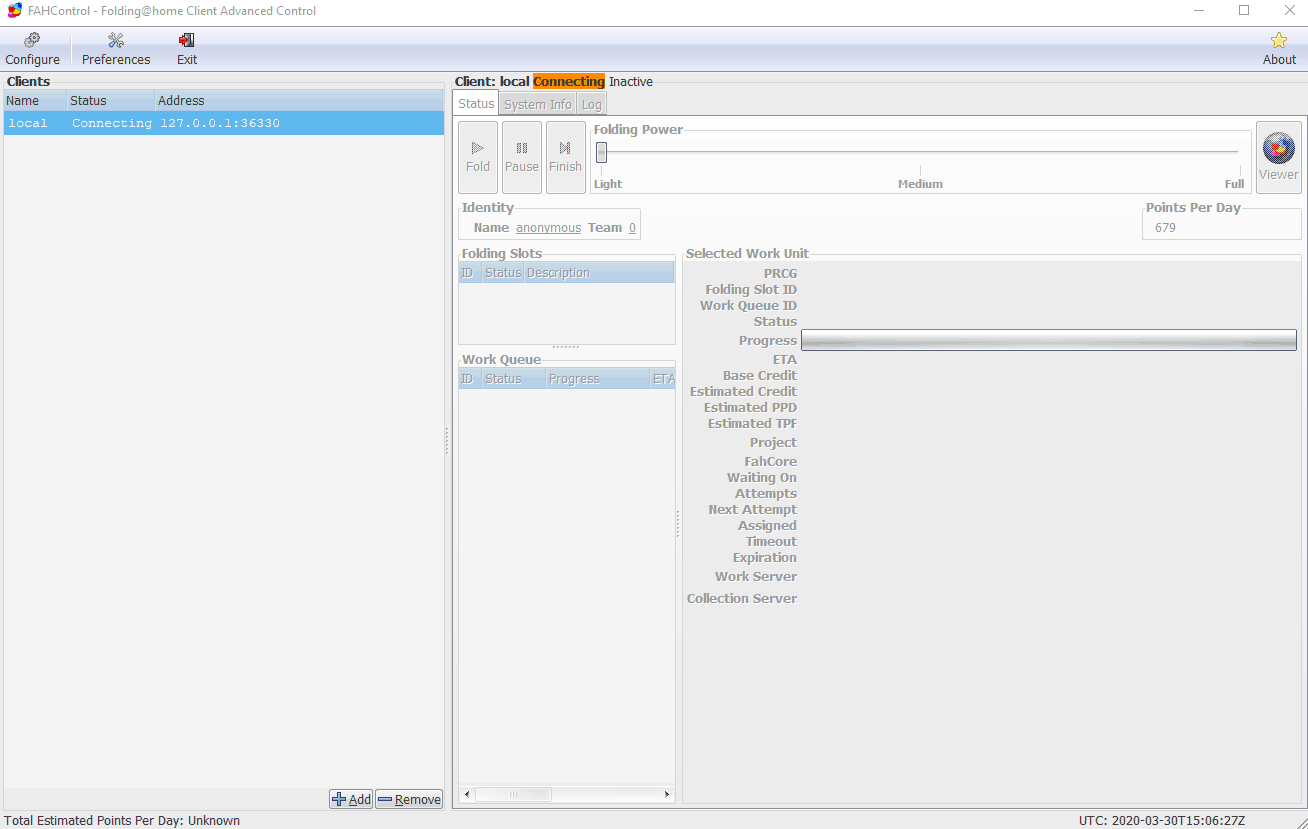
Ora possiamo aggiungere il nostro client in esecuzione sul VS implementato su Cyberfero. Sarà necessario l’indirizzo IP pubblico del VS e verificare di poter raggiungere la porta 36330.
Fare clic sul piccolo pulsante Aggiungi nella parte inferiore del client FAHControl e fornire il nome visualizzato, il nome host/indirizzo IP e la password impostati in precedenza.
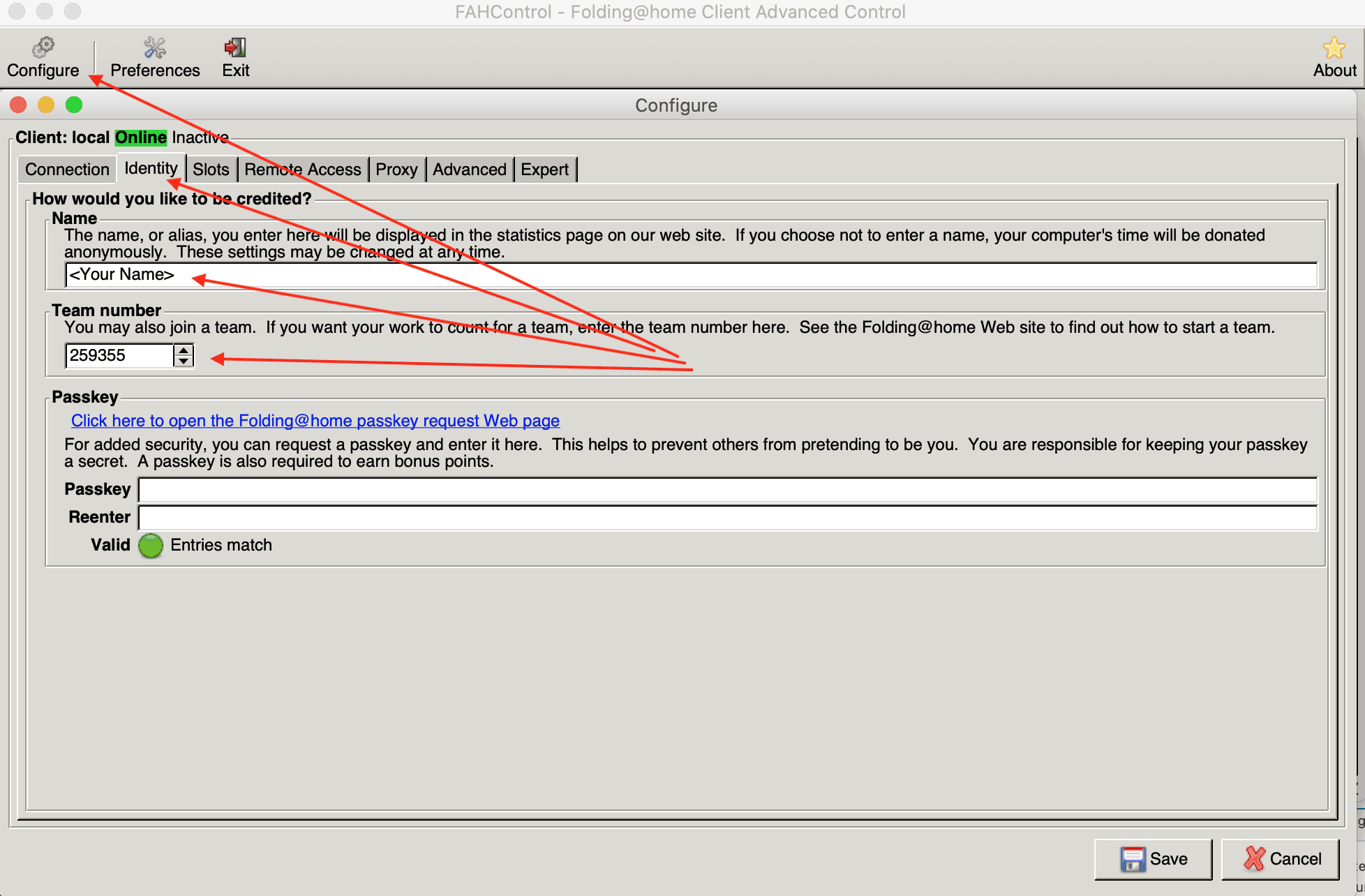
Nella sezione Configure, nella scheda Identity specifica il tuo nome e il nostro numero di Team che è 259355 come riportato di seguito:
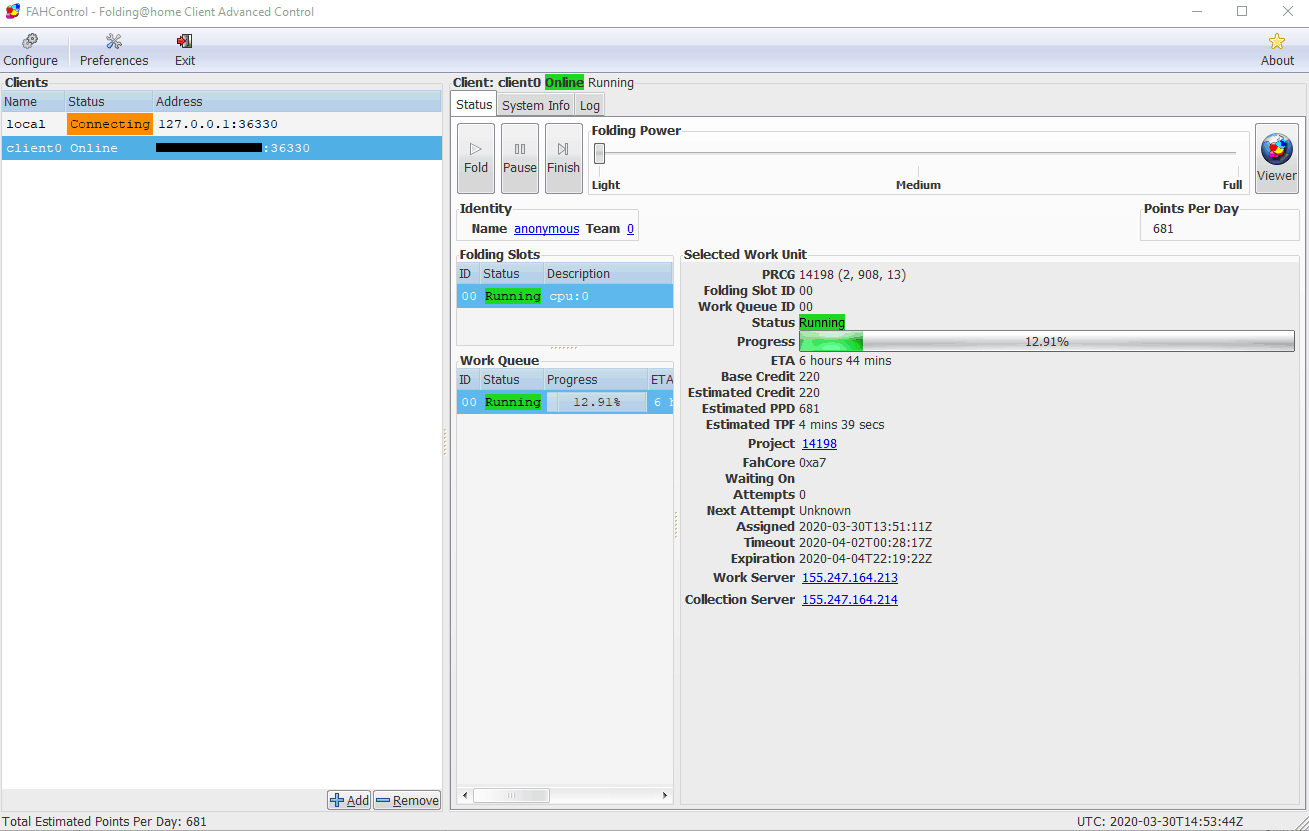
Ora dovresti vedere che FAHControl è connesso e funziona.
Per maggiori dettagli su come funziona e altre informazioni sul progetto Folding@home, visitare il sito https://foldingathome.org/.
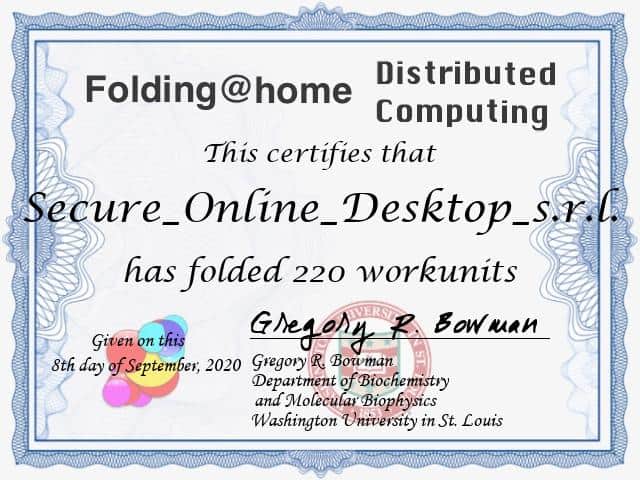
Infine puoi controllare le statistiche del nostro team qui: https://stats.foldingathome.org/team/259355 incluso il tuo contributo.

Vi preghiamo di notare che per aiutare il progetto Folding@home non è obbligatorio creare un VPS sul nostro Cloud, è possibile utilizzare anche il proprio PC per farlo. Il vantaggio di supportare il progetto Folding@home tramite il nostro VPS è che, diversamente dal tuo PC, puoi lasciare il processo sempre attivo e, ad esempio, puoi allocare risorse libere (come CPU e RAM) che hai incluso nel tuo abbonamento Cloud Server o SuperCloud .
Link utili:
ownCloud free for Corona Virus (COVID-19) emergency
Condividi


RSS
Piu’ articoli…
- Da Cyberfero a Cyberfero: il rebranding dell’azienda leader nella cybersecurity
- NIS2 – Come il nuovo regolamento cyber potenzia la sicurezza dell’Europa
- Advanced persistent threat (APT): cosa sono e come difendersi
- Penetration Testing e MFA: Una Strategia Duplice per Massimizzare la Sicurezza
- SOAR e l’automazione della sicurezza informatica
- Penetration Testing: Dove Colpire per Proteggere la Tua Rete Informatica
- Ransomware: una piaga che mette in ginocchio aziende e istituzioni. Pagare o non pagare? Ecco la risposta.
- Perché l’audit IT e il log management sono importanti per la Cybersecurity
Categorie …
- Backup as a Service (25)
- Acronis Cloud Backup (18)
- Veeam Cloud Connect (3)
- Cloud CRM (1)
- Cloud Server/VPS (23)
- Conferenza Cloud (4)
- Cyberfero (15)
- Log Management (2)
- Monitoraggio ICT (4)
- Novita' (21)
- ownCloud (7)
- Privacy (8)
- Security (215)
- Cyber Threat Intelligence (CTI) (9)
- Deception (4)
- Ethical Phishing (10)
- Netwrix Auditor (2)
- Penetration Test (18)
- Posture Guard (4)
- SOCaaS (66)
- Vulnerabilita' (83)
- Web Hosting (16)
Tags
 Feed sconosciuto
Full Disclosure
- Apache Struts2 Core Arbitrary Code Execution via OGNL Sandbox Escape Novembre 2, 2026Posted by Daniel Owens via Fulldisclosure on Nov 01Description Apache Struts2 Core version 7.4.0 and below attempt to prevent arbitrary code execution via Object-Graph Navigation Language (OGNL) through several different mechanisms but only in a cursory fashion -- the libraries only guard against immediate calls evaluated by the OGNL engine via `SecurityMemberAccess`, but an allowed […]
- Apache Struts2 Core TokenHelper Token Cryptographic Timing Side-Channel Novembre 2, 2026Posted by Daniel Owens via Fulldisclosure on Nov 01Description The Apache Struts2 Core 7.4.0 and below performs session token comparisons cryptographically insecure early-exit comparison functions (e.g., `!=`, `memcmp`, byte-by-byte loops with `break`) that return as soon as the first mismatched byte is encountered. The execution time of the comparison is therefore proportional to the number […]
- Apache Struts2 Spring Plugin Uses a Previously Closed Resource Novembre 2, 2026Posted by Daniel Owens via Fulldisclosure on Nov 01Description The Apache Struts2 Spring Plugin opens a Spring `ApplicationContex` via a try-with-resources block and, outside of said block, then continues to use the closed resource, resulting in an uncaught `IllegalStateException`. This particular issue prevents proper functionality and indicates poor code quality and code review standards and […]
- Apache Struts2 Core Integer Overflow Novembre 2, 2026Posted by Daniel Owens via Fulldisclosure on Nov 01Description Apache Struts2 Core version 7.4.0 and below fails to properly prevent integer overflows, causing wrap-arounds and other issues on a downstream forced casting into types smaller than `BigInteger`. Importantly, this finding underscores why all applications using Struts and other such platforms should perform their own input […]
- Apache Struts2 Core Cross-Origin Protection Exemption Miskeyed to a Deployment-Wide Path Novembre 2, 2026Posted by Daniel Owens via Fulldisclosure on Nov 01Description Apache Struts2 Core version 7.4.0 and below's `FetchMetadataInterceptor`, `CoepInterceptor`, and `CoopInterceptor` each compare their `exemptedPaths` configuration -- a per-interceptor-reference, administrator-supplied set of paths intended to exempt specific actions from the corresponding cross-origin protection -- against `HttpServletRequest.getContextPath()`. `getContextPath()` is fixed for the entire deployed web...
- Apache Struts2 REST Plugin Fails to Properly Parse Chunked Requests Novembre 2, 2026Posted by Daniel Owens via Fulldisclosure on Nov 01Description The Apache Struts2 REST Plugin's (version 7.4.0 and below) `ContentTypeInterceptor.intercept(ActionInvocation)` only deserialises a request body and enforces the `struts.rest.content.maxLength` bound when `HttpServletRequest#getContentLength()` returns a positive value. `getContentLength()` returns `-1` whenever the `Content-Length` header is absent, which normal and appropriate for any Hypertext Transfer Protocol (HTTP)...
- Apache Struts2 REST Plugin Untrimmed `Accept` Header Tokens Break Content Negation Fallback Novembre 2, 2026Posted by Daniel Owens via Fulldisclosure on Nov 01Description The Apache Struts2 REST Plugin's `DefaultContentTypeHandlerManager.getHandlerForResponse(HttpServletRequest, HttpServletResponse)` splits the `Accept` header on commas and passes each resulting token directly to `findHandler(String)` without trimming leading or trailing whitespace. `findHandler(String)` only retries a trimmed lookup when a token contains a semicolon (`;`), so a token that merely carries […]
- Apache Struts2 JSON Plugin Insecure Deserialisation -- Object Deserialisation Element-Count Limit Bypass Novembre 2, 2026Posted by Daniel Owens via Fulldisclosure on Nov 01As of the current versions of the Apache Struts2 JSON Plugin (e.g., version 7.4.0 and the 7.5.0 snapshot dated 28 October 2026), attackers can bypass the element-count limit purported to protect Object deserialisation added to said code as part of the WW-5618 and S2-072 "hardening controls". Please […]
- [0day-rubbish] NETGEAR RAX120 V1.2.5.18 authenticated SOAP InstallApp OS command injection to root-configured web-stack execution (6.8 Medium; conditionally 7.2 High with management exposure) Ottobre 29, 2026Posted by disclosure via Fulldisclosure on Oct 280day Rubbish Research Team is publicly disclosing a vulnerability in NETGEAR RAX120 (Nighthawk AX12) firmware V1.2.5.18, the WiFi 6 consumer router from NETGEAR (United States), built on the Qualcomm IPQ8074 platform. The administrative web plane of this firmware generation is a lighttpd server fronting the vendor's DNI-framework CGI […]
- [0day-rubbish] Raritan PX3 PDU G4 firmware 4.3.14 command injection in the ping and traceroute diagnostics through an inverted hostname-validation return check (8.8) Ottobre 29, 2026Posted by disclosure via Fulldisclosure on Oct 280day Rubbish Research Team is publicly disclosing a vulnerability in the Raritan PX3 PDU G4, firmware version 4.3.14, the intelligent rack power distribution unit from Raritan, a Legrand company (United States). A low-privilege authenticated session converts one diagnostics request into operating-system command execution in the product's web-service context, […]
Customers






Twitter FEED
Recent activity
-
SecureOnlineDesktop
Estimated reading time: 6 minutes L'impatto crescente delle minacce informatiche, su sistemi operativi privati op… https://t.co/FimxTS4o9G
-
SecureOnlineDesktop
Estimated reading time: 6 minutes The growing impact of cyber threats, on private or corporate operating systems… https://t.co/y6G6RYA9n1
-
SecureOnlineDesktop
Tempo di lettura stimato: 6 minuti Today we are talking about the CTI update of our services. Data security is… https://t.co/YAZkn7iFqa
-
SecureOnlineDesktop
Estimated reading time: 6 minutes Il tema della sicurezza delle informazioni è di grande attualità in questo peri… https://t.co/tfve5Kzr09
-
SecureOnlineDesktop
Estimated reading time: 6 minutes The issue of information security is very topical in this historical period ch… https://t.co/TP8gvdRcrF
Newsletter
Prodotti e Soluzioni
Collaborazioni
Modelli Cloud
News
- Da Cyberfero a Cyberfero: il rebranding dell’azienda leader nella cybersecurity Maggio 6, 2024
- NIS2 – Come il nuovo regolamento cyber potenzia la sicurezza dell’Europa Aprile 22, 2024
- Advanced persistent threat (APT): cosa sono e come difendersi Aprile 17, 2024
- Penetration Testing e MFA: Una Strategia Duplice per Massimizzare la Sicurezza Aprile 15, 2024
- SOAR e l’automazione della sicurezza informatica Marzo 27, 2024
Recensioni Google









Ottima azienda, servizi molto utili, staff qualificato e competente. Raccomandata!leggi di più
Ottimo supportoleggi di più
E'... un piacere poter collaborare con realtà di questo tipoleggi di più
Un ottimo fornitore.
Io personalmente ho parlato con l' Ing. Venuti, valore aggiunto indubbiamente.leggi di più


Contatti
© 2024 Cyberfero s.r.l. All Rights Reserved. Sede Legale: via Statuto 3 - 42121 Reggio Emilia (RE) – PEC [email protected] Cod. fiscale e P.IVA 03058120357 – R.E.A. 356650 Informativa Privacy - Certificazioni ISO