





 Piergiorgio Venuti
Application programming interface: our User API
In the IT development process, sooner or later we come across API services, which stands for Application Programming Interface. To date it is impossible to imagine IT development without. With the API it is possible to connect a service to an application and integrate it efficiently. Before introducing the specific APIs of the Cloud Server service, it is good to know broadly what an API is and why they are so used in computer science.
What is an API and how does it work?
An Application Programming Interface is like an open language, whose rules are shared by a certain service. By teaching the rules of language to an application, it can communicate with the service and access all the functions and data that are available.
Speaking a little more formal: the API is an interface that allows an app to interact with an external service through a set of commands. It is not necessary to know the internal logic of the service, just use a simple command and the service will return the requested data.
I want to propose an analogy that can be useful to understand this tool. When you enter a restaurant and talk to a waiter, you can order the dishes, ask questions on the menu, ask for the bill and so on. This person is like a filter that separates you from all the complications behind the scenes. You won’t have to worry about dishes, ovens, staff or food reserves. The waiter becomes the interface that allows you to take advantage of all the services, without having to worry about how a restaurant works. Here, the waiter can be interpreted as the API of the restaurant.
The specific command, the request (or call) method and the syntax to be used, are information described in the documentation of the service that offers the application programming interfaces.
Purposes

This powerful tool is now everywhere, so much so that often we do not even realize how many services we use via API. Mainly application programming interfaces are a great way to do one of the following:
Exchange of data
In the restaurant example, asking the waiter a question is like exchanging data. It would be like an answer to a question regarding the data made available.
Hide complex parts and perform operations
In the restaurant example, you don’t need to know how to cook a perfect lasagna, you will just order it. The request requires that the service provide a product, not simply raw data.
Extend functionality
For example, in mobile operating systems, widgets, which display useful information on the screen as part of the background, are used through APIs. The OS requires the app that provides the widget, all the information it needs to correctly show this functionality. This is also done via API.
Increase security
Since it is the OS that manages the authorizations for the use of the various hardware components, it is in charge of requesting the user for authorization to share a component. The SO is therefore responsible for the security and management of the data collected by the sensors of the mobile phone.
To learn more about the API topic, we share an explanation video from the Simply Explained channel.
Cyberfero User API
Cyberfero provides its User API to enable complete control of your account and services from your apps / systems. Through the HTTP REST API made available, it is also possible to resell the services with the white label formula, thus being able to brand the services in complete freedom.
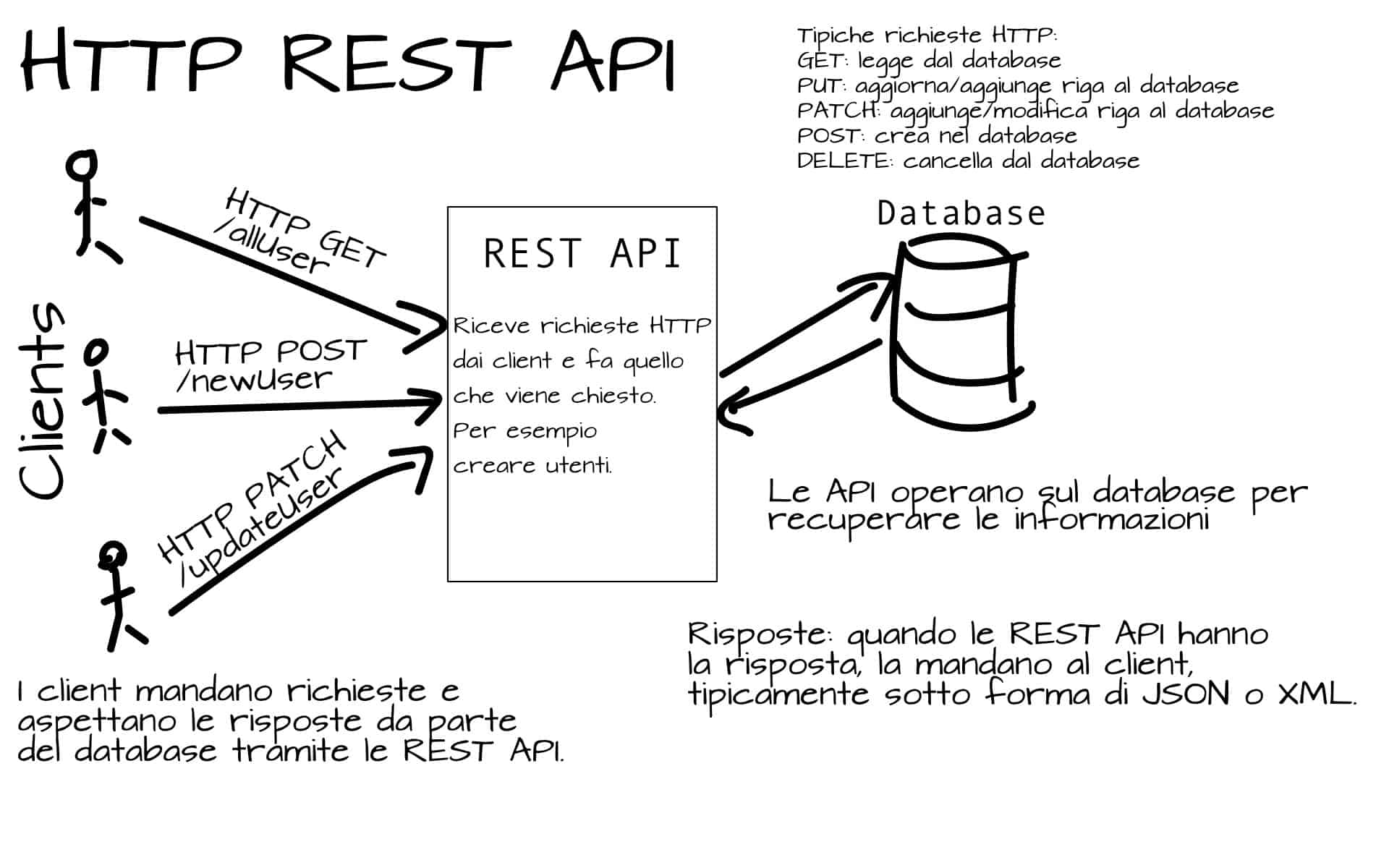
HTTP REST API
This type of API is characterized by communication via HTTP protocol and compliance with architectural principles defined as REpresentational State Transfer. If the HTTP protocol and its communication methods are well known and widely understood, perhaps it is good to mention the REST principles.
In a university analysis published as a thesis by Roy Fielding, the principles for a software architecture that would allow us to see the Web as a distributed computing platform were analyzed. According to this analysis, which hypothesized a generic architecture, the Web was found to have all that is needed to be considered a perfect platform for distributed processing.
A set of API which respects the REST logic hypothesized in 2000 by Roy Fielding, is called RESTful API. Although the terms create confusion, in reality they perfectly reflect the concept that REST is not a technology or a language, but are simply guidelines that can be respected or not.
White Label
Our APIs are offered specifically to offer the possibility to our customers to offer our services in white label mode. This means that our services can be offered to the customers of our customers, without them realizing anything.
The practice of white label, in fact, consists precisely in offering products without brands, with the specific aim of encouraging the rebranding of the service. Another interesting advantage derived from the use of APIs.
Conclusions
In addition to the possibility of offering our services to your customers in white label, you can also use the API to implement the services directly in your apps, expanding the available development possibilities.
The APIs are offered with complete documentation of all the request methods offered. A multitude of different API calls are allowed including management of users, domains, DNS, virtual machines and much more.
Summarizing, through Cyberfero’s HTTP REST API it is possible:
1. implement access to virtual machines, hypervisors, network, disks, backups and much more in their applications
2. offer our re-branded services to your customers
Request further information or advice.
Useful links:
Share


RSS
More Articles…
- From Cyberfero to Cyberfero: rebranding of the leading cybersecurity company
- NIS: what it is and how it protects cybersecurity
- Advanced persistent threats (APTs): what they are and how to defend yourself
- Penetration Testing and MFA: A Dual Strategy to Maximize Security
- Penetration Testing: Where to Strike to Protect Your IT Network
- Ransomware: a plague that brings companies and institutions to their knees. Should you pay the ransom? Here is the answer.
- Why IT audit and log management are important for Cybersecurity
- Red Team, Blue Team and Purple Team: what are the differences?
Categories …
- Backup as a Service (18)
- Acronis Cloud Backup (11)
- Veeam Cloud Connect (4)
- Cloud Conference (3)
- Cloud CRM (1)
- Cloud Server/VPS (22)
- Conferenza Cloud (4)
- Cyberfero (15)
- ICT Monitoring (5)
- Log Management (2)
- News (25)
- ownCloud (4)
- Privacy (7)
- Security (203)
- Cyber Threat Intelligence (CTI) (8)
- Deception (4)
- Ethical Phishing (11)
- Netwrix Auditor (2)
- Penetration Test (11)
- Posture Guard (3)
- SOCaaS (65)
- Vulnerabilities (84)
- Web Hosting (15)
Tags
 Unknown Feed
Full Disclosure
- [0day-rubbish] TRENDnet TV-IP302PI firmware 1.02.38 authenticated NTP server-address OS command injection to root command execution via a shell-form system() call (7.2 High, PR:H) October 20, 2026Posted by disclosure via Fulldisclosure on Oct 200day Rubbish Research Team is publicly disclosing a vulnerability in TRENDnet TV-IP302PI firmware 1.02.38, the closed-source IP surveillance camera from TRENDnet (United States). The camera's application daemon is shipped at /hunt/hunt_server: an ARM 32-bit EABI5 version 5TE soft-float binary, dynamically linked against /lib/ld-linux.so.3, 4.5 MB and stripped. Its […]
- [0day-rubbish] Royal Render 9.1.26b: default-unauthenticated job submission on rrServer TCP 7773 reaches worker-side shell execution as the worker identity, measured root (8.1 High) October 20, 2026Posted by disclosure via Fulldisclosure on Oct 200day Rubbish Research Team is publicly disclosing a vulnerability in Royal Render 9.1.26b, the closed-source render-farm job manager for VFX and animation studios from Binary Alchemy (proprietor Holger Schoenberger) of Ludwigsburg, Germany. Royal Render is a different product from the Royal Server gateway sold by Royal Apps GmbH […]
- [0day-rubbish] ProSoft Technology RLX-IFH24E v2.2.44 unsigned firmware upgrade package to root command execution and full account-database overwrite (7.2) October 20, 2026Posted by disclosure via Fulldisclosure on Oct 200day Rubbish Research Team is publicly disclosing a vulnerability in the ProSoft RLX-IFH24E, version v2.2.44, the industrial wireless radio from ProSoft Technology, Inc. (United States). The appliance is a closed-source embedded device and an OEM build of the MicroHard Systems IPx21 platform on the MHX-910 board design: an […]
- [0day-rubbish] Parasoft Continuous Testing Platform 10.7.5-SNAPSHOT anonymous deserialization in the database restore path to JSP command execution as uid=1000 (9.8) October 20, 2026Posted by disclosure via Fulldisclosure on Oct 200day Rubbish Research Team is publicly disclosing a vulnerability in Parasoft Continuous Testing Platform 10.7.5-SNAPSHOT, the closed-source commercial continuous-testing, service-virtualisation and environment-management product from Parasoft, a United States software-testing vendor headquartered in Monrovia, California. The affected component is the em web application inside the vendor's own container image, […]
- [0day-rubbish] Exasol Database 7.1.30 docker-db form: shipped default SYS credential to PYTHON3 UDF os.popen command execution as uid=500(exadefusr), output returned in-band (8.8) October 20, 2026Posted by disclosure via Fulldisclosure on Oct 200day Rubbish Research Team is publicly disclosing a vulnerability in Exasol Database 7.1.30, the in-memory MPP analytical database from Exasol AG (Germany), examined in its docker-db single-container deployment form. The SQL engine is a proprietary C implementation named EXASolution, the server process is exacts, clients speak a proprietary […]
- [0day-rubbish] Edimax BR-6478AC firmware v2.20 authenticated command injection in the setWAN WAN-configuration handler, root command execution (7.2) October 20, 2026Posted by disclosure via Fulldisclosure on Oct 200day Rubbish Research Team is publicly disclosing a vulnerability in the Edimax BR-6478AC, firmware image BR6478AC_v2.20.bin, the dual-band AC1750 SOHO wireless router from Edimax Technology Co., Ltd. (Taiwan). A single authenticated POST that looks like an ordinary WAN settings submission reaches system() with a request-controlled username interpolated unquoted […]
- [0day-rubbish] Edimax BR-6478AC firmware v2.20 authenticated command injection in the formWlanMP manufacturing-test handler, root command execution (7.2) October 20, 2026Posted by disclosure via Fulldisclosure on Oct 200day Rubbish Research Team is publicly disclosing a vulnerability in the Edimax BR-6478AC, firmware image BR6478AC_v2.20.bin, the dual-band AC1750 SOHO wireless router from Edimax Technology Co., Ltd. (Taiwan). A single authenticated POST to a manufacturing radio-calibration route that is still registered in production firmware reaches system() with thirty […]
- [ROOTEDCON] Call for Papers 2027 · RootedCON2027 (Madrid) October 20, 2026Posted by Román Ramírez on Oct 20-=] About RootedCON RootedCON is a technology and cybersecurity conference that will take place in Madrid (Spain) from March 4 to 6, 2027. This will be our XVII EDITION! With an attendance of between 9,000 and 10,000 people, it is the most relevant specialized conference in the country and […]
- VestaCP <= 0.9.8-26: authenticated config-parser eval sinks -> root RCE (VESTACP-2026-001) October 15, 2026Posted by Bryan Ramirez via Fulldisclosure on Oct 15Advisory ID: VESTACP-2026-001 / GHSA-m2mc-xwq7-pw72 Product: Vesta Control Panel (VestaCP) Versions:
- [SYSS-2026-080]: dcm4che - Path Traversal (CWE-22) October 15, 2026Posted by Matthias Deeg via Fulldisclosure on Oct 15Advisory ID: SYSS-2026-080 Product: dcm4che Manufacturer: J4Care Affected Version(s): 5.35.0 Tested Version(s): 5.35.0 Vulnerability Type: Improper Limitation of a Pathname to a Restricted Directory (CWE-22) Risk Level: High Solution Status: Open Manufacturer Notification: 2026-08-06 Public Disclosure: 2026-10-13 CVE Reference: Not yet...
Customers






Twitter FEED
Recent activity
-
SecureOnlineDesktop
Estimated reading time: 6 minutes L'impatto crescente delle minacce informatiche, su sistemi operativi privati op… https://t.co/FimxTS4o9G
-
SecureOnlineDesktop
Estimated reading time: 6 minutes The growing impact of cyber threats, on private or corporate operating systems… https://t.co/y6G6RYA9n1
-
SecureOnlineDesktop
Tempo di lettura stimato: 6 minuti Today we are talking about the CTI update of our services. Data security is… https://t.co/YAZkn7iFqa
-
SecureOnlineDesktop
Estimated reading time: 6 minutes Il tema della sicurezza delle informazioni è di grande attualità in questo peri… https://t.co/tfve5Kzr09
-
SecureOnlineDesktop
Estimated reading time: 6 minutes The issue of information security is very topical in this historical period ch… https://t.co/TP8gvdRcrF
Newsletter
Products and Solutions
Partners
Cloud Models
News
- From Cyberfero to Cyberfero: rebranding of the leading cybersecurity company May 6, 2024
- NIS: what it is and how it protects cybersecurity April 22, 2024
- Advanced persistent threats (APTs): what they are and how to defend yourself April 17, 2024
- Penetration Testing and MFA: A Dual Strategy to Maximize Security April 15, 2024
- Penetration Testing: Where to Strike to Protect Your IT Network March 25, 2024
Google Reviews









Ottima azienda, servizi molto utili, staff qualificato e competente. Raccomandata!read more
Ottimo supportoread more
E'... un piacere poter collaborare con realtà di questo tiporead more
Un ottimo fornitore.
Io personalmente ho parlato con l' Ing. Venuti, valore aggiunto indubbiamente.read more


About
© 2024 Cyberfero s.r.l. All Rights Reserved. Sede Legale: via Statuto 3 - 42121 Reggio Emilia (RE) – PEC [email protected] Cod. fiscale e P.IVA 03058120357 – R.E.A. 356650 Informativa Privacy - Certificazioni ISO