





 Piergiorgio Venuti
ClearOS: Linux Server for Small Business
ClearOS (formerly ClarkConnect) is a Linux distribution, with the aim of transforming any standard PC into a dedicated firewall and Internet server / gateway. The software is a solution for small businesses, home offices and networked homes. ClearOS is based on CentOS and offers a very robust set of tools organized in easy to navigate administration pages.
Small business and servers
Small business data centers often rely on one-size-fits-all solutions for standard problems. Because’? They save on costs. Within the Linux world, there are a number of exceptional server software that can help power a business in ways that aren’t always considered.
The problem with small businesses that use Linux can often come in the form of distribution complexity. While Linux has come a long way in terms of ease of use, there can sometimes be an additional level of complexity when it comes to server software. This additional learning curve is very often easily overcome by anyone with a moderate level of computer skills. Note that for anyone who has used Linux before, this is generally a breeze.
But then, who needs a data center solution, without the burden of a high-level IT expert on hand, who could they turn to? One solution is ClearOS.
What is ClearOS
According to the presentation material of the distribution:
“ClearOS is a simple, open and affordable operating system, with an intuitive web-based graphical user interface and a marketplace with over 100 applications to choose from, with more being added every day. By leveraging open source software, you decide which apps you need and only pay for the apps and support you want. “
To verify that these statements respect reality and check that ClearOS is indeed an interesting solution, let’s see the details together.
Editions
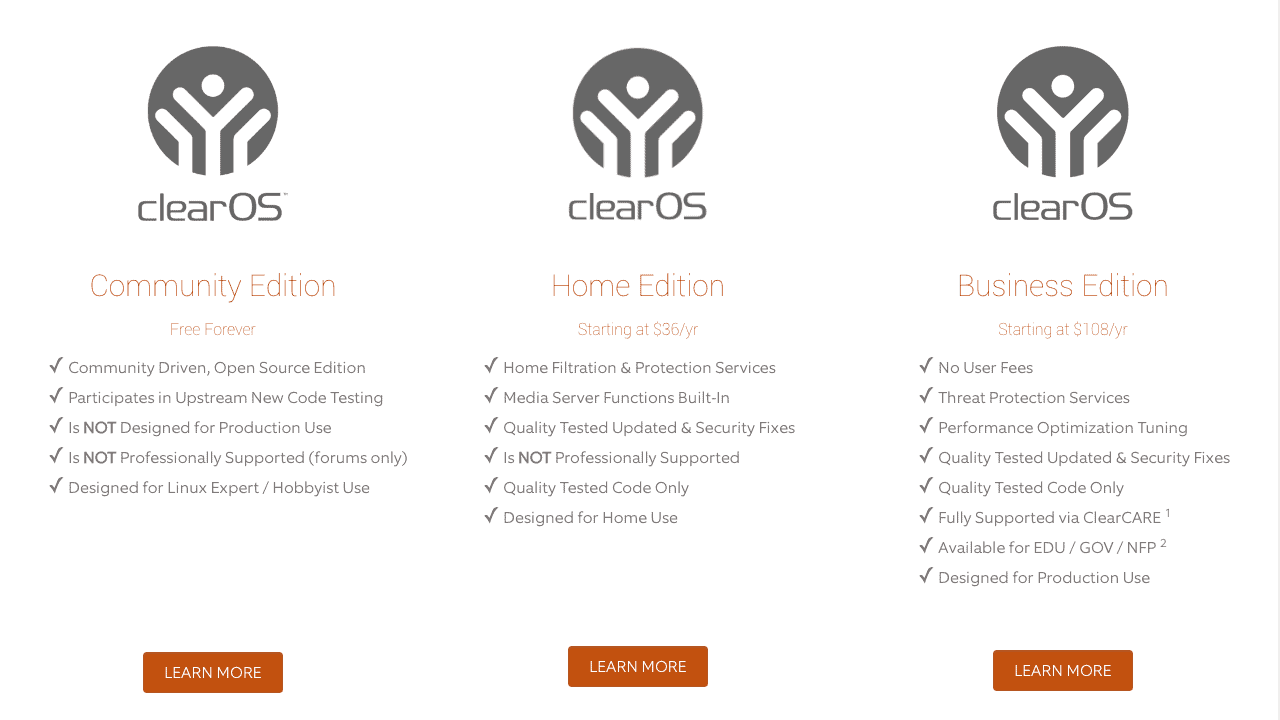
First, you need to choose between the versions of the operating system. In fact, ClearOS offers three different platform distributions:
– Community: the free edition of ClearOS
– Home: Ideal for home offices
– Business: Ideal for small businesses, thanks to the inclusion of paid support
To find out the differences of each edition, you can consult the ClearOS function matrix here. There are also the prices on the page which, after all, are contained for the proposed service.
Installation
There is really no need to talk about the ClearOS installation process, as it is incredibly simple. If you’ve ever installed Linux, you won’t have any problems with ClearOS.
I wanted to test it with a VirtualBox on my personal computer, and in just 20 minutes I had a working virtual machine with ClearOS ready. The installation time includes the post-installation wizard and the first updates.
Once you have completed the basic installation, post-installation wizard and updates, all done from within an incredibly well-designed web interface, you are ready to start adding applications from the ClearOS Marketplace, which is ‘where the platform really shines.
Taking a look at the process of adding applications to the ClearOS server, it is evident how easy this ecosystem is to use. Once we are done with the initial setup, we are on the “ClearOS Marketplace Getting Started” page. From this screen it is possible to manage the application selection and installation process.
The operating system also comes with a couple of preconfigurations to choose from. In any case, you will have the possibility to choose through the selection of applications / services to be installed on the ClearOS server.
ClearOS functionality
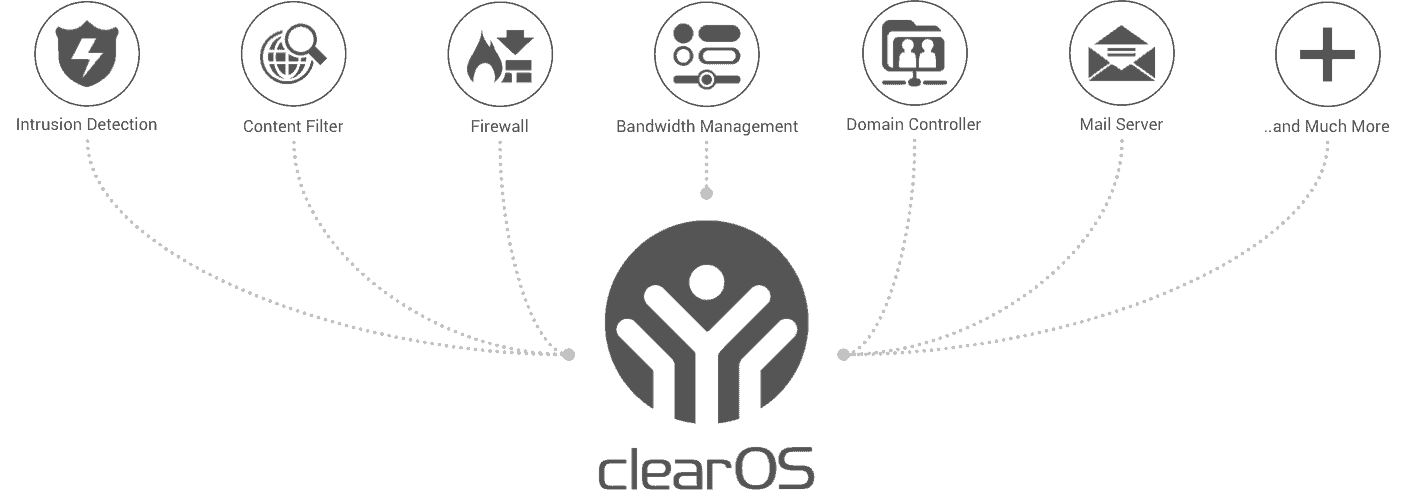
Available features include:
– Firewall, Networking and Security:
– Network: the firewall restricts access to systems and provides advanced features, including DMZ, NAT 1 to 1 and Port Forwarding
– Protocol: Peer-to-Peer discovery system allows you to manage the use of peer-to-peer file sharing
– Application: Intrusion Detection and Intrusion Prevention systems provide an additional layer of defense against threats to your network.
– Virtual Private Networking
– Web Proxy and Content Filter
– Email, including Webmail
– Groupware
– Database and Web Server
– File and print services
Costs App
Some of the apps are free, while others have a cost. You have to consult the list of available apps to see if any of these apps / services meet your needs and fit your budget. Once you have selected all the applications you want to install, you can proceed with the installation.
At this point you are ready to configure the custom dashboard. If you don’t want to worry about customizing the dashboard, you can use the default one. The dashboard allows you to select what you want to view through practical drop-down menus. It is also possible to immediately start configuring newly installed applications.
One remarkable thing is that ClearOS has made configuring the LDAP service extremely easy. Normally this process can be quite a headache, but ClearOS has found a way to make it as painless as possible.
The function of ClearOS
One thing not found on ClearOS is a tool for creating a server environment like that of a Microsoft Small Business Server or its successor Windows Server. So, using applications like MS Office, via Terminal Server, will not work. But you can always install the Dropbox app for free and use their Paper Server. This, of course, is not a real alternative for a full office suite, but it is still a partial solution.
However, this is not the point of ClearOS, as the intent is more to serve a business-class server that can help protect and expand a small business network. In other words, if you are looking for an incredibly simple firewall to set up and manage, VPN, DNS, DHCP, and a well-rounded general network appliance, ClearOS is exactly what you need. If you are looking for something to replace a Samba server, ClearOS is not the solution.
ClearOS can be found among the standard Cyberfero templates and you can then install your own VPS with ClearOS in a few seconds.
Useful links:
Share


RSS
More Articles…
- From Cyberfero to Cyberfero: rebranding of the leading cybersecurity company
- NIS: what it is and how it protects cybersecurity
- Advanced persistent threats (APTs): what they are and how to defend yourself
- Penetration Testing and MFA: A Dual Strategy to Maximize Security
- Penetration Testing: Where to Strike to Protect Your IT Network
- Ransomware: a plague that brings companies and institutions to their knees. Should you pay the ransom? Here is the answer.
- Why IT audit and log management are important for Cybersecurity
- Red Team, Blue Team and Purple Team: what are the differences?
Categories …
- Backup as a Service (18)
- Acronis Cloud Backup (11)
- Veeam Cloud Connect (4)
- Cloud Conference (3)
- Cloud CRM (1)
- Cloud Server/VPS (22)
- Conferenza Cloud (4)
- Cyberfero (15)
- ICT Monitoring (5)
- Log Management (2)
- News (25)
- ownCloud (4)
- Privacy (7)
- Security (203)
- Cyber Threat Intelligence (CTI) (8)
- Deception (4)
- Ethical Phishing (11)
- Netwrix Auditor (2)
- Penetration Test (11)
- Posture Guard (3)
- SOCaaS (65)
- Vulnerabilities (84)
- Web Hosting (15)
Tags
 Unknown Feed
Full Disclosure
- Apache Struts2 Core Arbitrary Code Execution via OGNL Sandbox Escape November 2, 2026Posted by Daniel Owens via Fulldisclosure on Nov 01Description Apache Struts2 Core version 7.4.0 and below attempt to prevent arbitrary code execution via Object-Graph Navigation Language (OGNL) through several different mechanisms but only in a cursory fashion -- the libraries only guard against immediate calls evaluated by the OGNL engine via `SecurityMemberAccess`, but an allowed […]
- Apache Struts2 Core TokenHelper Token Cryptographic Timing Side-Channel November 2, 2026Posted by Daniel Owens via Fulldisclosure on Nov 01Description The Apache Struts2 Core 7.4.0 and below performs session token comparisons cryptographically insecure early-exit comparison functions (e.g., `!=`, `memcmp`, byte-by-byte loops with `break`) that return as soon as the first mismatched byte is encountered. The execution time of the comparison is therefore proportional to the number […]
- Apache Struts2 Spring Plugin Uses a Previously Closed Resource November 2, 2026Posted by Daniel Owens via Fulldisclosure on Nov 01Description The Apache Struts2 Spring Plugin opens a Spring `ApplicationContex` via a try-with-resources block and, outside of said block, then continues to use the closed resource, resulting in an uncaught `IllegalStateException`. This particular issue prevents proper functionality and indicates poor code quality and code review standards and […]
- Apache Struts2 Core Integer Overflow November 2, 2026Posted by Daniel Owens via Fulldisclosure on Nov 01Description Apache Struts2 Core version 7.4.0 and below fails to properly prevent integer overflows, causing wrap-arounds and other issues on a downstream forced casting into types smaller than `BigInteger`. Importantly, this finding underscores why all applications using Struts and other such platforms should perform their own input […]
- Apache Struts2 Core Cross-Origin Protection Exemption Miskeyed to a Deployment-Wide Path November 2, 2026Posted by Daniel Owens via Fulldisclosure on Nov 01Description Apache Struts2 Core version 7.4.0 and below's `FetchMetadataInterceptor`, `CoepInterceptor`, and `CoopInterceptor` each compare their `exemptedPaths` configuration -- a per-interceptor-reference, administrator-supplied set of paths intended to exempt specific actions from the corresponding cross-origin protection -- against `HttpServletRequest.getContextPath()`. `getContextPath()` is fixed for the entire deployed web...
- Apache Struts2 REST Plugin Fails to Properly Parse Chunked Requests November 2, 2026Posted by Daniel Owens via Fulldisclosure on Nov 01Description The Apache Struts2 REST Plugin's (version 7.4.0 and below) `ContentTypeInterceptor.intercept(ActionInvocation)` only deserialises a request body and enforces the `struts.rest.content.maxLength` bound when `HttpServletRequest#getContentLength()` returns a positive value. `getContentLength()` returns `-1` whenever the `Content-Length` header is absent, which normal and appropriate for any Hypertext Transfer Protocol (HTTP)...
- Apache Struts2 REST Plugin Untrimmed `Accept` Header Tokens Break Content Negation Fallback November 2, 2026Posted by Daniel Owens via Fulldisclosure on Nov 01Description The Apache Struts2 REST Plugin's `DefaultContentTypeHandlerManager.getHandlerForResponse(HttpServletRequest, HttpServletResponse)` splits the `Accept` header on commas and passes each resulting token directly to `findHandler(String)` without trimming leading or trailing whitespace. `findHandler(String)` only retries a trimmed lookup when a token contains a semicolon (`;`), so a token that merely carries […]
- Apache Struts2 JSON Plugin Insecure Deserialisation -- Object Deserialisation Element-Count Limit Bypass November 2, 2026Posted by Daniel Owens via Fulldisclosure on Nov 01As of the current versions of the Apache Struts2 JSON Plugin (e.g., version 7.4.0 and the 7.5.0 snapshot dated 28 October 2026), attackers can bypass the element-count limit purported to protect Object deserialisation added to said code as part of the WW-5618 and S2-072 "hardening controls". Please […]
- [0day-rubbish] NETGEAR RAX120 V1.2.5.18 authenticated SOAP InstallApp OS command injection to root-configured web-stack execution (6.8 Medium; conditionally 7.2 High with management exposure) October 29, 2026Posted by disclosure via Fulldisclosure on Oct 280day Rubbish Research Team is publicly disclosing a vulnerability in NETGEAR RAX120 (Nighthawk AX12) firmware V1.2.5.18, the WiFi 6 consumer router from NETGEAR (United States), built on the Qualcomm IPQ8074 platform. The administrative web plane of this firmware generation is a lighttpd server fronting the vendor's DNI-framework CGI […]
- [0day-rubbish] Raritan PX3 PDU G4 firmware 4.3.14 command injection in the ping and traceroute diagnostics through an inverted hostname-validation return check (8.8) October 29, 2026Posted by disclosure via Fulldisclosure on Oct 280day Rubbish Research Team is publicly disclosing a vulnerability in the Raritan PX3 PDU G4, firmware version 4.3.14, the intelligent rack power distribution unit from Raritan, a Legrand company (United States). A low-privilege authenticated session converts one diagnostics request into operating-system command execution in the product's web-service context, […]
Customers






Twitter FEED
Recent activity
-
SecureOnlineDesktop
Estimated reading time: 6 minutes L'impatto crescente delle minacce informatiche, su sistemi operativi privati op… https://t.co/FimxTS4o9G
-
SecureOnlineDesktop
Estimated reading time: 6 minutes The growing impact of cyber threats, on private or corporate operating systems… https://t.co/y6G6RYA9n1
-
SecureOnlineDesktop
Tempo di lettura stimato: 6 minuti Today we are talking about the CTI update of our services. Data security is… https://t.co/YAZkn7iFqa
-
SecureOnlineDesktop
Estimated reading time: 6 minutes Il tema della sicurezza delle informazioni è di grande attualità in questo peri… https://t.co/tfve5Kzr09
-
SecureOnlineDesktop
Estimated reading time: 6 minutes The issue of information security is very topical in this historical period ch… https://t.co/TP8gvdRcrF
Newsletter
Products and Solutions
Partners
Cloud Models
News
- From Cyberfero to Cyberfero: rebranding of the leading cybersecurity company May 6, 2024
- NIS: what it is and how it protects cybersecurity April 22, 2024
- Advanced persistent threats (APTs): what they are and how to defend yourself April 17, 2024
- Penetration Testing and MFA: A Dual Strategy to Maximize Security April 15, 2024
- Penetration Testing: Where to Strike to Protect Your IT Network March 25, 2024
Google Reviews

Ottima azienda, servizi molto utili, staff qualificato e competente. Raccomandata!read more
Ottimo supportoread more
E'... un piacere poter collaborare con realtà di questo tiporead more
Un ottimo fornitore.
Io personalmente ho parlato con l' Ing. Venuti, valore aggiunto indubbiamente.read more


About
© 2024 Cyberfero s.r.l. All Rights Reserved. Sede Legale: via Statuto 3 - 42121 Reggio Emilia (RE) – PEC [email protected] Cod. fiscale e P.IVA 03058120357 – R.E.A. 356650 Informativa Privacy - Certificazioni ISO