





 Piergiorgio Venuti
Monitoring system, an overview
Monitoring system with and without agents
Zabbix can be used both with agents and without agents (software dedicated to collecting information in a system). Agents are optionally installed on IT components to monitor performance and collect data. The agent then responds to a centralized management server. This information is included in the reports or presented visually in the web-based graphical interface. If there is a problem with what is being monitored, the system sends a notification or warning to the user. Agentless monitoring performs the same type of monitoring by using existing resources in a system or device to emulate an agent. The Zabbix web-based graphical interface allows users to visualize their IT environment via customizable dashboards based on widgets, charts, network maps, slideshows and reports. For example, a user can customize a report to show metrics associated with both SLAs (Service Level Agreements) and KPIs (Key Performance Indicators) on CPU loads.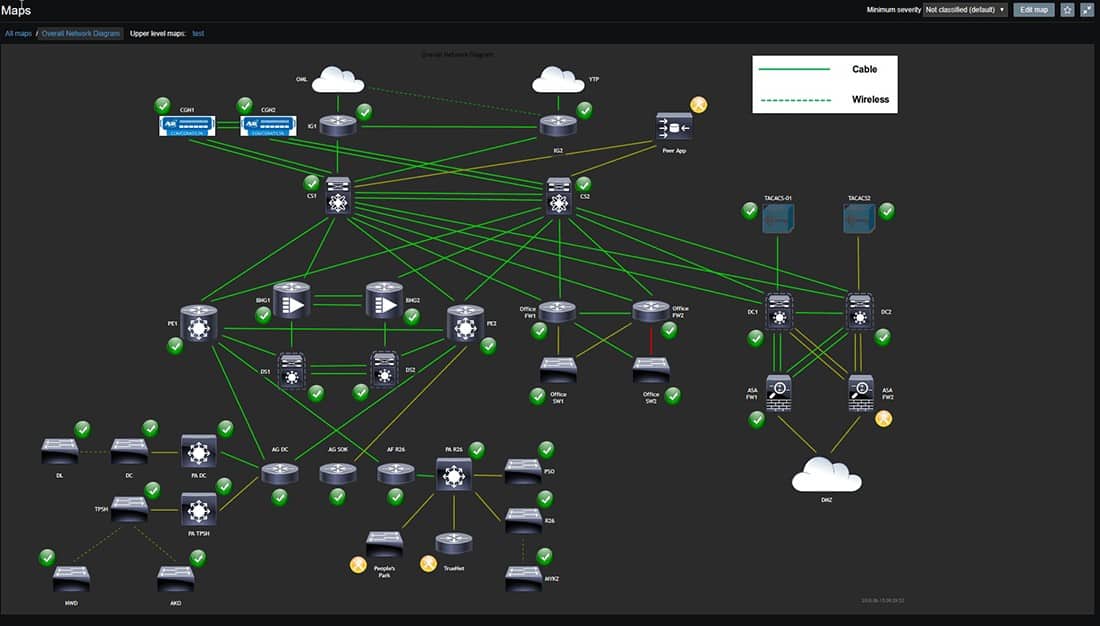
An example of a map of the monitoring system within a perimeter
The three discovery modes
The monitoring system offered works through three discovery mode options: – Network discovery periodically scans an IT environment and records device type, IP address, status, uptime and downtime. – Low-level discovery (LLD) automatically creates elements, triggers and graphs based on the discovered device. Low-level discovery can create metrics from Simple Network Management Protocol (SNMP) object identifiers, Windows services, Structured Query Language (SQL) queries, network interfaces, and more. – Auto-discovery automatically starts monitoring any device discovered using a Zabbix agent. With the distributed monitoring system, scripts run remotely collect data from multiple devices in distributed locations and combine them into a single dashboard or report, such as server availability across the country.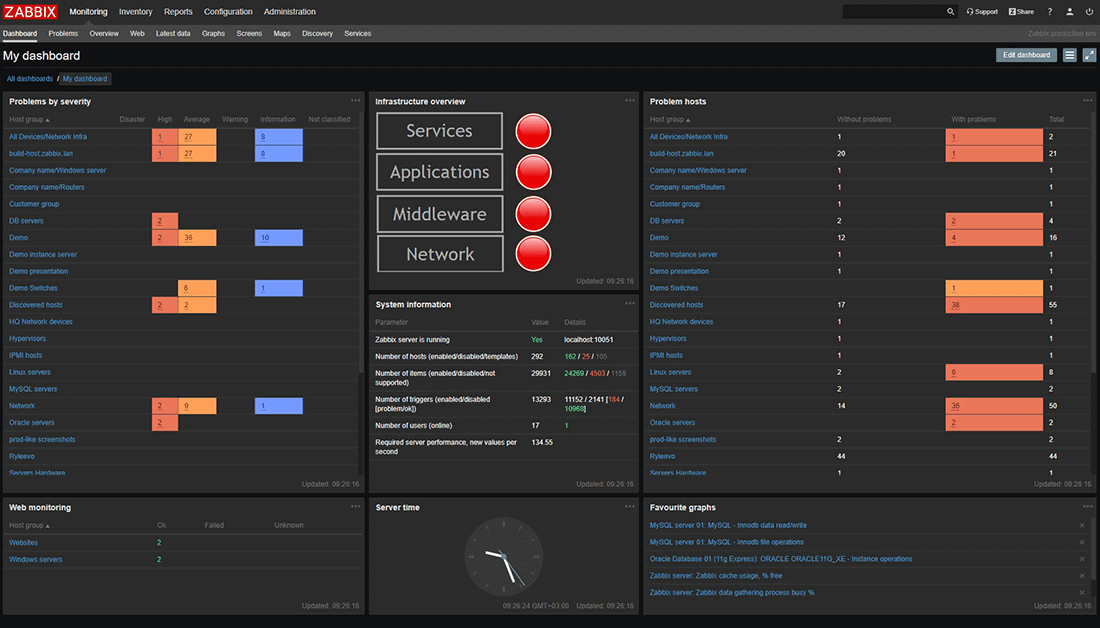
The graphical interface offers data ranging from system health to error severity and location, as well as monitoring details
Agentless monitoring system
Zabbix offers several monitoring options in addition to agents. A simple check can verify the availability and responsiveness of a standard service, such as notifications. Java management extensions (JMX), web monitoring, and other methods are also alternatives to using agents. In the service offered, JMX can be used to monitor Java based applications. Web monitoring is used to check the availability of websites and supports HTTP and HTTPS. The system collects data relating to the average download speed of a scenario, errors and error messages, response times and more.The Zabbix API
The system provides web-based APIs to create new applications, automate tasks and integrate with third-party software.The JavaScript Object Notation (JSON) format is used to use the API as a front-end web interface. The Zabbix API consists of many methods which are grouped into separate APIs, each of which performs a specific service. For example, one method to create a new host is host.create; the method to log in as administrator is user.login. Using the API, monitoring system users can create applications to work with and view desired information.Template
Templates are custom add-ons that extend the functionality of the monitoring system offered. Some models are made by Zabbix and come packaged with ready-to-use software, while others are built by users. Templates allow Zabbix users to monitor network devices from vendors such as Cisco, Dell, HP and Juniper. Other models can be used to monitor IBM, HP and Super Micro servers. Templates for application-based services include Microsoft Exchange and Exchange Server, Zenoss, PowerDNS, Authoritative Server Stats, and more. Templates can be created to monitor operating systems as well.Conclusions
SOD provides an advanced monitoring system service that will allow you to keep your entire IT infrastructure under control. The monitoring possibilities are very wide and we have covered them in another article. The web interface facilitates the management and control for your perimeter, adding the possibility to set customized alarms and specific templates for every need. If you are interested in the service, you can test it and see it working in our demo. Registration is required but no payment. Contact us for further questions or request a consultation, we are at your disposal. Useful links:Share


RSS
More Articles…
- From Cyberfero to Cyberfero: rebranding of the leading cybersecurity company
- NIS: what it is and how it protects cybersecurity
- Advanced persistent threats (APTs): what they are and how to defend yourself
- Penetration Testing and MFA: A Dual Strategy to Maximize Security
- Penetration Testing: Where to Strike to Protect Your IT Network
- Ransomware: a plague that brings companies and institutions to their knees. Should you pay the ransom? Here is the answer.
- Why IT audit and log management are important for Cybersecurity
- Red Team, Blue Team and Purple Team: what are the differences?
Categories …
- Backup as a Service (18)
- Acronis Cloud Backup (11)
- Veeam Cloud Connect (4)
- Cloud Conference (3)
- Cloud CRM (1)
- Cloud Server/VPS (22)
- Conferenza Cloud (4)
- Cyberfero (15)
- ICT Monitoring (5)
- Log Management (2)
- News (25)
- ownCloud (4)
- Privacy (7)
- Security (203)
- Cyber Threat Intelligence (CTI) (8)
- Deception (4)
- Ethical Phishing (11)
- Netwrix Auditor (2)
- Penetration Test (11)
- Posture Guard (3)
- SOCaaS (65)
- Vulnerabilities (84)
- Web Hosting (15)
Tags
 Unknown Feed
Full Disclosure
- [0day-rubbish] Royal Server 5.04.50529.0 Local privilege escalation to LocalSystem on the execution path without credential override (7.2) September 8, 2026Posted by disclosure via Fulldisclosure on Sep 08TO: fulldisclosure () seclists org SUBJECT: [0day-rubbish] Royal Server 5.04.50529.0 Local privilege escalation to LocalSystem on the execution path without credential override (7.2) FROM: disclosure () 0day-rubbish com ----BODY---- 0day Rubbish Research Team is publicly disclosing a vulnerability in Royal Server 5.04.50529.0. Type: Local privilege escalation to LocalSystem […]
- [0day-rubbish] core-admin 1.0.164 (build 16468) Systemic shell command injection via ineffective quote escaping (8.8) September 8, 2026Posted by disclosure via Fulldisclosure on Sep 08TO: fulldisclosure () seclists org SUBJECT: [0day-rubbish] core-admin 1.0.164 (build 16468) Systemic shell command injection via ineffective quote escaping (8.8) FROM: disclosure () 0day-rubbish com ----BODY---- 0day Rubbish Research Team is publicly disclosing a vulnerability in core-admin 1.0.164 (build 16468). Type: Systemic shell command injection via ineffective quote […]
- [0day-rubbish] OP5 Monitor 9.20 Command injection surviving the CVE-2025-34115 patch (OPT-IN fix ineffective) (8.8) September 8, 2026Posted by disclosure via Fulldisclosure on Sep 08TO: fulldisclosure () seclists org SUBJECT: [0day-rubbish] OP5 Monitor 9.20 Command injection surviving the CVE-2025-34115 patch (OPT-IN fix ineffective) (8.8) FROM: disclosure () 0day-rubbish com ----BODY---- 0day Rubbish Research Team is publicly disclosing a vulnerability in OP5 Monitor 9.20. Type: Command injection surviving the CVE-2025-34115 patch (OPT-IN fix […]
- [0day-rubbish] QuantaStor 6.8.3.018 Command injection in the alert-mail command via the smtpPassword field (8.8) September 8, 2026Posted by disclosure via Fulldisclosure on Sep 08TO: fulldisclosure () seclists org SUBJECT: [0day-rubbish] QuantaStor 6.8.3.018 Command injection in the alert-mail command via the smtpPassword field (8.8) FROM: disclosure () 0day-rubbish com ----BODY---- 0day Rubbish Research Team is publicly disclosing a vulnerability in QuantaStor 6.8.3.018. Type: Command injection in the alert-mail command via the smtpPassword […]
- [0day-rubbish] SmarterMail 100.0.9693 (Build 9693) Antivirus command-line configuration executing as NT AUTHORITY\SYSTEM (7.2) September 8, 2026Posted by disclosure via Fulldisclosure on Sep 08TO: fulldisclosure () seclists org SUBJECT: [0day-rubbish] SmarterMail 100.0.9693 (Build 9693) Antivirus command-line configuration executing as NT AUTHORITY\SYSTEM (7.2) FROM: disclosure () 0day-rubbish com ----BODY---- 0day Rubbish Research Team is publicly disclosing a vulnerability in SmarterMail 100.0.9693 (Build 9693). Type: Antivirus command-line configuration executing as NT AUTHORITY\SYSTEM (CWE-250) […]
- [0day-rubbish] Jitterbit Agent 12.8.1.6 (Docker jitterbit/agent:12.8.1.6) Unauthenticated SOAP with hard-coded credentials leading to OS command execution (9.8) September 8, 2026Posted by disclosure via Fulldisclosure on Sep 08TO: fulldisclosure () seclists org SUBJECT: [0day-rubbish] Jitterbit Agent 12.8.1.6 (Docker jitterbit/agent:12.8.1.6) Unauthenticated SOAP with hard-coded credentials leading to OS command execution (9.8) FROM: disclosure () 0day-rubbish com ----BODY---- 0day Rubbish Research Team is publicly disclosing a vulnerability in Jitterbit Agent 12.8.1.6 (Docker jitterbit/agent:12.8.1.6). Type: Unauthenticated SOAP with […]
- [0day-rubbish] Accurate Online Private Cloud on-prem (current) Unauthenticated Hessian deserialization leading to JNDI remote class loading (9.8) September 8, 2026Posted by disclosure via Fulldisclosure on Sep 08TO: fulldisclosure () seclists org SUBJECT: [0day-rubbish] Accurate Online Private Cloud on-prem (current) Unauthenticated Hessian deserialization leading to JNDI remote class loading (9.8) FROM: disclosure () 0day-rubbish com ----BODY---- 0day Rubbish Research Team is publicly disclosing a vulnerability in Accurate Online Private Cloud on-prem (current). Type: Unauthenticated Hessian […]
- [0day-rubbish] DBxtra .NET 13.1.1.0 Unauthenticated SOAP API to xp_cmdshell code execution (9.8) September 8, 2026Posted by disclosure via Fulldisclosure on Sep 08TO: fulldisclosure () seclists org SUBJECT: [0day-rubbish] DBxtra .NET 13.1.1.0 Unauthenticated SOAP API to xp_cmdshell code execution (9.8) FROM: disclosure () 0day-rubbish com ----BODY---- 0day Rubbish Research Team is publicly disclosing a vulnerability in DBxtra .NET 13.1.1.0. Type: Unauthenticated SOAP API to xp_cmdshell code execution (CWE-306) CVSS: 9.8 […]
- **Subject:** CVE-2026-2035703: Tozed ZLT X300 5G CPE — Unauthenticated Remote Root Code Execution via TR-069 Command Injection (CVSS 9.8) September 8, 2026Posted by Surf free on Sep 08Tozed ZLT X300 5G CPE Router firmware 6.01.3 contains an OS command injection vulnerability (CWE-78) in the TR-069/CWMP client daemon (netcwmpd). The IPPingDiagnostics Host parameter is passed unsanitized into sprintf, which constructs a shell command executed via system_by_root() as root. An attacker operating a rogue LTE base station using […]
- CVE-2026-52307: Stored XSS in 1CMS v5.6 September 8, 2026Posted by 懒-癌-症~ via Fulldisclosure on Sep 08CVE-2026-52307: 1CMS v5.6 Authenticated Stored XSS Vulnerability Vulnerability Description An authenticated stored cross-site scripting (XSS) vulnerability exists in the Column Management component of ClassCMS 1CMS v5.6. Attackers can execute arbitrary web scripts or HTML by injecting a crafted payload into the title field. - Vulnerability Type: Cross Site […]
Customers






Twitter FEED
Recent activity
-
SecureOnlineDesktop
Estimated reading time: 6 minutes L'impatto crescente delle minacce informatiche, su sistemi operativi privati op… https://t.co/FimxTS4o9G
-
SecureOnlineDesktop
Estimated reading time: 6 minutes The growing impact of cyber threats, on private or corporate operating systems… https://t.co/y6G6RYA9n1
-
SecureOnlineDesktop
Tempo di lettura stimato: 6 minuti Today we are talking about the CTI update of our services. Data security is… https://t.co/YAZkn7iFqa
-
SecureOnlineDesktop
Estimated reading time: 6 minutes Il tema della sicurezza delle informazioni è di grande attualità in questo peri… https://t.co/tfve5Kzr09
-
SecureOnlineDesktop
Estimated reading time: 6 minutes The issue of information security is very topical in this historical period ch… https://t.co/TP8gvdRcrF
Newsletter
Products and Solutions
Partners
Cloud Models
News
- From Cyberfero to Cyberfero: rebranding of the leading cybersecurity company May 6, 2024
- NIS: what it is and how it protects cybersecurity April 22, 2024
- Advanced persistent threats (APTs): what they are and how to defend yourself April 17, 2024
- Penetration Testing and MFA: A Dual Strategy to Maximize Security April 15, 2024
- Penetration Testing: Where to Strike to Protect Your IT Network March 25, 2024
Google Reviews


Davvero consigliata !!!!!
In particolare vorrei sottolineare la figura che piu’ racchiude e sintetizza le qualità della Secure Online Desktop , il suo AD Ing. Piergiorgio Venuti, professionista impagabile , sia dal punto di vista tecnico/organizzativo che soprattutto (e non dimeno) come persona , capace di gestire , risolvere e approcciare qualsivoglia attività/problematica, davvero un grande !!!!







Tempi veloci e staff preparato!
Ottima azienda, servizi molto utili, staff qualificato e competente. Raccomandata!read more
Ottimo supportoread more
E' un piacere poter collaborare con realtà di questo tiporead more
Un ottimo fornitore.
Io personalmente ho parlato con l' Ing. Venuti, valore aggiunto indubbiamente.read more


About
© 2024 Cyberfero s.r.l. All Rights Reserved. Sede Legale: via Statuto 3 - 42121 Reggio Emilia (RE) – PEC [email protected] Cod. fiscale e P.IVA 03058120357 – R.E.A. 356650 Informativa Privacy - Certificazioni ISO