





 Piergiorgio Venuti
PageSpeed Insight: better speed with Google
If the site is slow, you are losing customers. It’s very simple and there are no kinder ways to say the same thing. The speed of a site is directly proportional to the desire of a user to visit it. To measure your portal you can use a tool made available by Google: PageSpeed Insight. You can access this service from the Plesk control panel offered by Cyberfero, simply by clicking on the icon at the bottom of the site panel.
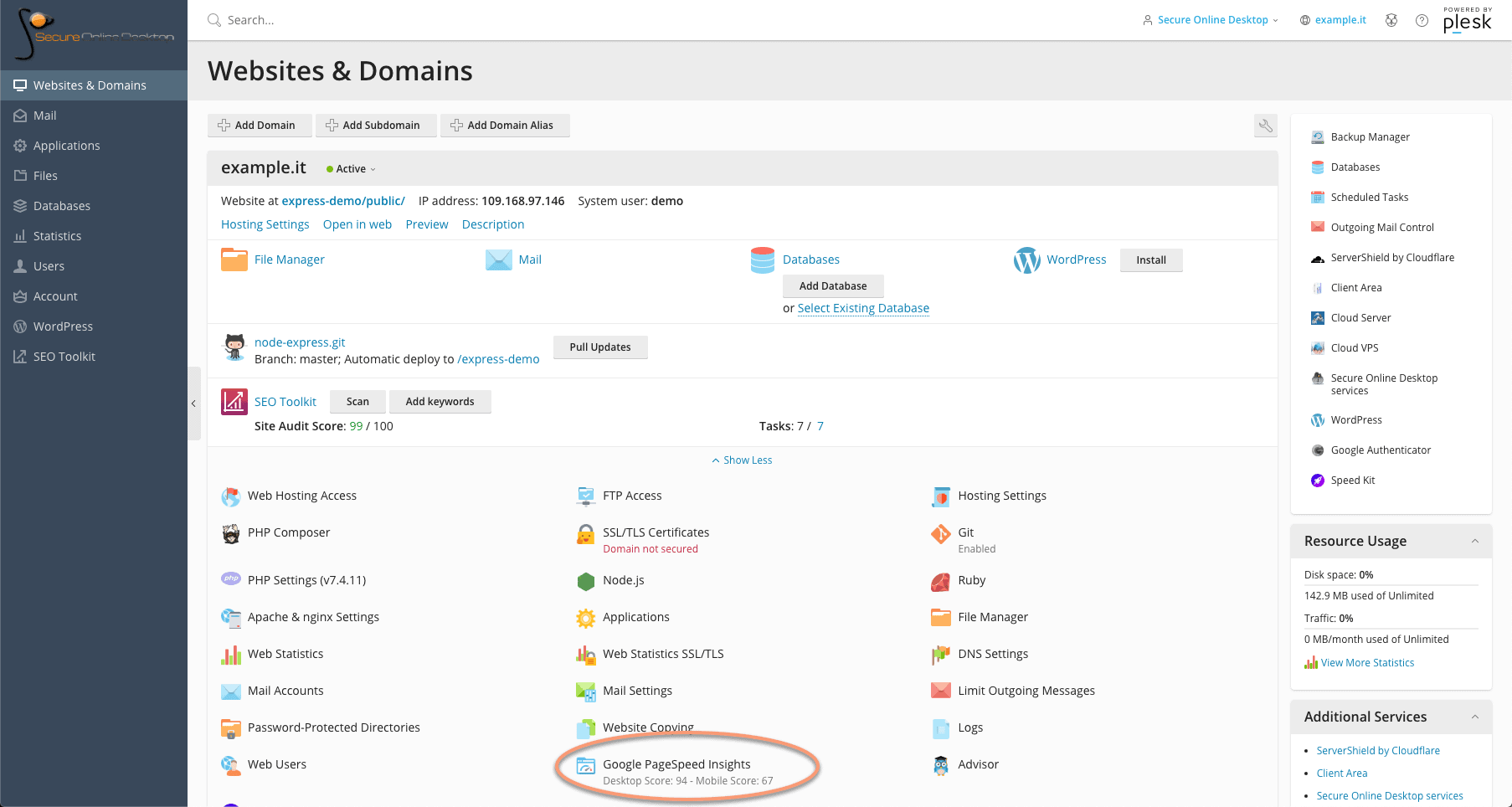
Today we try to understand how this tool can help us improve the user experience on our site and also the positioning for search engines (SEO). In this regard, I recommend checking the data of a research carried out by Backlinko in which they tested how different on-site and off-site parameters affect positioning, the search is in English but has also been translated into Italian.
Why is speed important?
The speed of your website has a direct impact on SEO and conversion rates. Not taking the time to make improvements can be a costly mistake. Users are much more likely to leave a slow website without even visiting it, and the likelihood of this happening increases by over 100% if a page’s load time goes from 1s to 6s. In particular, the bouncing rate (percentage of users who leave without visiting other pages) is in the following parameters:
– Loading up to 3 seconds: bouncing rate + 32%
– Loading up to 5 seconds: bouncing rate + 90%
– Up to 6 seconds: bouncing rate + 106%
There is a real need for speed, and Google’s free PageSpeed Insights tool is a fantastic resource to help you find and fix problems that could slow down your site.
What is PageSpeed Insight
PageSpeed Insights is a free tool offered by Google to help analyze the performance of a website and receive suggestions on how to improve it. In fact, it’s probably the most popular page speed analysis tool out there, so it’s worth learning how to use.
PageSpeed provides a speed index in cents, the maximum of which is obviously 100/100. Before you rush to figure out how to get that score, you need to know how to use the tool correctly and implement the suggestions it provides. In fact, not only is a score produced, but also the weak points that affect the score, loading times and suggestions for improving it are shown.
Let’s see some useful information to better understand how PageSpeed Insight works.
PageSpeed and loading time
The PageSpeed Insight tool does not measure the loading time of your site. Despite what people think. To understand what that means, let’s see the difference between PageSpeed and page load time.
PageSpeed
PageSpeed is the score given by Google with its PageSpeed Insights tool. This tool takes the raw performance metrics and converts them to a score between 1 and 100. While it will offer diagnostic reporting and opportunities as part of the report, they do not directly contribute to the performance score.
This means that PageSpeed Insight alone is not actually a real indicator of a site’s loading time.
Loading time
So what is loading time compared to PageSpeed? It is the average time it takes a page to be loaded by a user. It is not a calculated score, it is the actual loading time of a page, in seconds or milliseconds, between the beginning and the end of the content loading.
Of course, the loading time alone does not give an idea of what is causing speed problems or how to fix them.
How does the tool work?
Once you have accessed the tool from the hosting control panel, you will find us in front of a lot of information.
The Google PagesSpeed Insights tool provides both lab data and field data for each page. Lab data is collected in a controlled environment when a page is scanned and is a great way to identify performance problems and find solutions to solve them. Field data, on the other hand, is collected from real-world performance data when users load the page. Some of the problems and obvious bottlenecks that make conversion more difficult for real visitors may arise here.
In short: the tool shows a performance score out of a total of 100. However, the performance metric results used to calculate it are not weighted equally. Things like “first contentful paint” (the first time you see something on the screen) have a greater effect.
There are particular data that have different influences on the final score shown in hundredths. To find out what to improve to increase your PageSpeed score, you need to analyze the sections that contain page-specific data.
The sections
In practice, the screen displayed in the control panel first of all shows a table showing the loaded resources and their size. Next there are the “Lab Data”, “Load Opportunities” and “Diagnostic” sections.
Each section lists all the tests that have been passed, those that need to be improved and those that show problems. It is all shown with a color-code which helps to immediately pinpoint where the problems are.
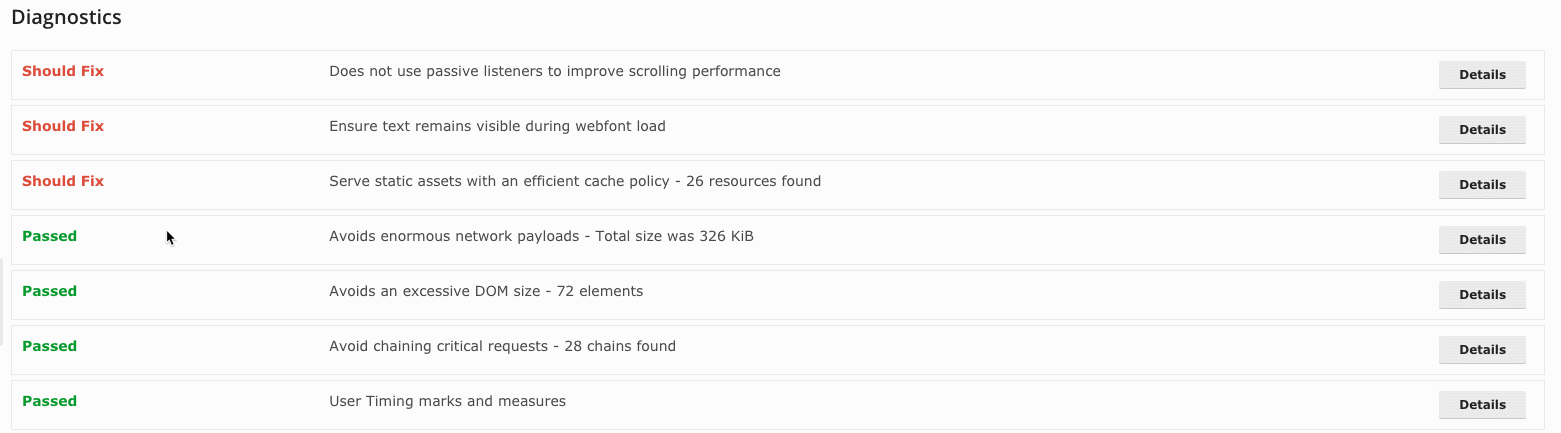 Just click on the “Details” button to get more information and check what is wrong.
Conclusions
The tool is offered free of charge and provides important data for webmasters who want to monetize the site and pay attention to conversions. Each item on the list is accompanied by a link that provides further information on that specific topic.
Improving a certain aspect of your site will be much easier, having clues on how to proceed. Especially if you make sales on the site, if you try to convert your visitors, the speed of the pages is a parameter to work on carefully to optimize it as much as possible.
The control panel of the Cyberfero web hosting service natively offers this opportunity to analyze the site, conveniently without having to go to other pages. Try the service before purchasing and personally check the convenience of the hosting control panel.
Useful links:
Share


RSS
More Articles…
- From Cyberfero to Cyberfero: rebranding of the leading cybersecurity company
- NIS: what it is and how it protects cybersecurity
- Advanced persistent threats (APTs): what they are and how to defend yourself
- Penetration Testing and MFA: A Dual Strategy to Maximize Security
- Penetration Testing: Where to Strike to Protect Your IT Network
- Ransomware: a plague that brings companies and institutions to their knees. Should you pay the ransom? Here is the answer.
- Why IT audit and log management are important for Cybersecurity
- Red Team, Blue Team and Purple Team: what are the differences?
Categories …
- Backup as a Service (18)
- Acronis Cloud Backup (11)
- Veeam Cloud Connect (4)
- Cloud Conference (3)
- Cloud CRM (1)
- Cloud Server/VPS (22)
- Conferenza Cloud (4)
- Cyberfero (15)
- ICT Monitoring (5)
- Log Management (2)
- News (25)
- ownCloud (4)
- Privacy (7)
- Security (203)
- Cyber Threat Intelligence (CTI) (8)
- Deception (4)
- Ethical Phishing (11)
- Netwrix Auditor (2)
- Penetration Test (11)
- Posture Guard (3)
- SOCaaS (65)
- Vulnerabilities (84)
- Web Hosting (15)
Tags
 Unknown Feed
Full Disclosure
- [0day-rubbish] TRENDnet TV-IP302PI firmware 1.02.38 authenticated NTP server-address OS command injection to root command execution via a shell-form system() call (7.2 High, PR:H) October 20, 2026Posted by disclosure via Fulldisclosure on Oct 200day Rubbish Research Team is publicly disclosing a vulnerability in TRENDnet TV-IP302PI firmware 1.02.38, the closed-source IP surveillance camera from TRENDnet (United States). The camera's application daemon is shipped at /hunt/hunt_server: an ARM 32-bit EABI5 version 5TE soft-float binary, dynamically linked against /lib/ld-linux.so.3, 4.5 MB and stripped. Its […]
- [0day-rubbish] Royal Render 9.1.26b: default-unauthenticated job submission on rrServer TCP 7773 reaches worker-side shell execution as the worker identity, measured root (8.1 High) October 20, 2026Posted by disclosure via Fulldisclosure on Oct 200day Rubbish Research Team is publicly disclosing a vulnerability in Royal Render 9.1.26b, the closed-source render-farm job manager for VFX and animation studios from Binary Alchemy (proprietor Holger Schoenberger) of Ludwigsburg, Germany. Royal Render is a different product from the Royal Server gateway sold by Royal Apps GmbH […]
- [0day-rubbish] ProSoft Technology RLX-IFH24E v2.2.44 unsigned firmware upgrade package to root command execution and full account-database overwrite (7.2) October 20, 2026Posted by disclosure via Fulldisclosure on Oct 200day Rubbish Research Team is publicly disclosing a vulnerability in the ProSoft RLX-IFH24E, version v2.2.44, the industrial wireless radio from ProSoft Technology, Inc. (United States). The appliance is a closed-source embedded device and an OEM build of the MicroHard Systems IPx21 platform on the MHX-910 board design: an […]
- [0day-rubbish] Parasoft Continuous Testing Platform 10.7.5-SNAPSHOT anonymous deserialization in the database restore path to JSP command execution as uid=1000 (9.8) October 20, 2026Posted by disclosure via Fulldisclosure on Oct 200day Rubbish Research Team is publicly disclosing a vulnerability in Parasoft Continuous Testing Platform 10.7.5-SNAPSHOT, the closed-source commercial continuous-testing, service-virtualisation and environment-management product from Parasoft, a United States software-testing vendor headquartered in Monrovia, California. The affected component is the em web application inside the vendor's own container image, […]
- [0day-rubbish] Exasol Database 7.1.30 docker-db form: shipped default SYS credential to PYTHON3 UDF os.popen command execution as uid=500(exadefusr), output returned in-band (8.8) October 20, 2026Posted by disclosure via Fulldisclosure on Oct 200day Rubbish Research Team is publicly disclosing a vulnerability in Exasol Database 7.1.30, the in-memory MPP analytical database from Exasol AG (Germany), examined in its docker-db single-container deployment form. The SQL engine is a proprietary C implementation named EXASolution, the server process is exacts, clients speak a proprietary […]
- [0day-rubbish] Edimax BR-6478AC firmware v2.20 authenticated command injection in the setWAN WAN-configuration handler, root command execution (7.2) October 20, 2026Posted by disclosure via Fulldisclosure on Oct 200day Rubbish Research Team is publicly disclosing a vulnerability in the Edimax BR-6478AC, firmware image BR6478AC_v2.20.bin, the dual-band AC1750 SOHO wireless router from Edimax Technology Co., Ltd. (Taiwan). A single authenticated POST that looks like an ordinary WAN settings submission reaches system() with a request-controlled username interpolated unquoted […]
- [0day-rubbish] Edimax BR-6478AC firmware v2.20 authenticated command injection in the formWlanMP manufacturing-test handler, root command execution (7.2) October 20, 2026Posted by disclosure via Fulldisclosure on Oct 200day Rubbish Research Team is publicly disclosing a vulnerability in the Edimax BR-6478AC, firmware image BR6478AC_v2.20.bin, the dual-band AC1750 SOHO wireless router from Edimax Technology Co., Ltd. (Taiwan). A single authenticated POST to a manufacturing radio-calibration route that is still registered in production firmware reaches system() with thirty […]
- [ROOTEDCON] Call for Papers 2027 · RootedCON2027 (Madrid) October 20, 2026Posted by Román Ramírez on Oct 20-=] About RootedCON RootedCON is a technology and cybersecurity conference that will take place in Madrid (Spain) from March 4 to 6, 2027. This will be our XVII EDITION! With an attendance of between 9,000 and 10,000 people, it is the most relevant specialized conference in the country and […]
- VestaCP <= 0.9.8-26: authenticated config-parser eval sinks -> root RCE (VESTACP-2026-001) October 15, 2026Posted by Bryan Ramirez via Fulldisclosure on Oct 15Advisory ID: VESTACP-2026-001 / GHSA-m2mc-xwq7-pw72 Product: Vesta Control Panel (VestaCP) Versions:
- [SYSS-2026-080]: dcm4che - Path Traversal (CWE-22) October 15, 2026Posted by Matthias Deeg via Fulldisclosure on Oct 15Advisory ID: SYSS-2026-080 Product: dcm4che Manufacturer: J4Care Affected Version(s): 5.35.0 Tested Version(s): 5.35.0 Vulnerability Type: Improper Limitation of a Pathname to a Restricted Directory (CWE-22) Risk Level: High Solution Status: Open Manufacturer Notification: 2026-08-06 Public Disclosure: 2026-10-13 CVE Reference: Not yet...
Customers






Twitter FEED
Recent activity
-
SecureOnlineDesktop
Estimated reading time: 6 minutes L'impatto crescente delle minacce informatiche, su sistemi operativi privati op… https://t.co/FimxTS4o9G
-
SecureOnlineDesktop
Estimated reading time: 6 minutes The growing impact of cyber threats, on private or corporate operating systems… https://t.co/y6G6RYA9n1
-
SecureOnlineDesktop
Tempo di lettura stimato: 6 minuti Today we are talking about the CTI update of our services. Data security is… https://t.co/YAZkn7iFqa
-
SecureOnlineDesktop
Estimated reading time: 6 minutes Il tema della sicurezza delle informazioni è di grande attualità in questo peri… https://t.co/tfve5Kzr09
-
SecureOnlineDesktop
Estimated reading time: 6 minutes The issue of information security is very topical in this historical period ch… https://t.co/TP8gvdRcrF
Newsletter
Products and Solutions
Partners
Cloud Models
News
- From Cyberfero to Cyberfero: rebranding of the leading cybersecurity company May 6, 2024
- NIS: what it is and how it protects cybersecurity April 22, 2024
- Advanced persistent threats (APTs): what they are and how to defend yourself April 17, 2024
- Penetration Testing and MFA: A Dual Strategy to Maximize Security April 15, 2024
- Penetration Testing: Where to Strike to Protect Your IT Network March 25, 2024
Google Reviews









Ottima azienda, servizi molto utili, staff qualificato e competente. Raccomandata!read more
Ottimo supportoread more
E'... un piacere poter collaborare con realtà di questo tiporead more
Un ottimo fornitore.
Io personalmente ho parlato con l' Ing. Venuti, valore aggiunto indubbiamente.read more


About
© 2024 Cyberfero s.r.l. All Rights Reserved. Sede Legale: via Statuto 3 - 42121 Reggio Emilia (RE) – PEC [email protected] Cod. fiscale e P.IVA 03058120357 – R.E.A. 356650 Informativa Privacy - Certificazioni ISO