





 Piergiorgio Venuti
Mitre Att&ck ™: an overview
Mitre Att&ck is a global knowledge base of adversary tactics and techniques based on real observations of cyber attacks. These are displayed in arrays organized by attack tactics, from initial system access and data theft to machine control. There are arrays for common desktop platforms (Linux, macOS and Windows) and for mobile ones.
What is MITRE ATT&CK ™ and what does it mean?
ATT&CK stands for “adversarial tactics, techniques, and common knowledge” and that is: tactics, adversary techniques and common knowledge. Let’s try to go deeper.
Tactics and techniques are a modern way of thinking about cyber attacks. Rather than looking at the results of an attack – an indicator of compromise (IoC) – security analysts should look at the tactics and techniques that indicate an attack is in progress. Tactics represent the goal you want to achieve, while techniques represent how an opponent plans to achieve it.
Common knowledge is the documented use of tactics and techniques used by opponents. Essentially, common knowledge is the documentation of the procedures used by the attacker. Those familiar with cybersecurity may be familiar with the term “tactics, techniques and procedures” or TTP. This same concept has been used by ATT&CK ™, replacing the term procedure with common knowledge.
Who is MITRE and what is the goal of ATT&CK ™?
MITRE is a US government funded research organization based in Bedford, MA, and McLean, VA. The company was spun off from MIT in 1958 and was involved in a number of top secret commercial projects for various agencies. These included the development of the FAA’s air traffic control system and the AWACS radar system. MITRE has a substantial cybersecurity practice funded by the National Institute of Standards and Technology (NIST).
A curiosity: the word Mitre means nothing. Apparently one of the first members, James McCormack, wanted a name that meant nothing but was evocative. Some mistakenly think it means Massachusetts Institute of Technology Research and Engineering.
ATT&CK’s goal is to create a comprehensive list of known opponent tactics and techniques used during a cyber attack. Open to governmental, educational and commercial organizations, it should be able to gather a wide, and hopefully comprehensive, range of attack phases and sequences. MITRE ATT&CK aims to create a standard taxonomy to make communications between organizations more specific.
How is the ATT&CK ™ matrix used?
The matrix visually organizes all known tactics and techniques in an easy to understand format. Attack tactics are shown above, and individual techniques are listed below in each column. An attack sequence would involve at least one technique per tactic, and a complete attack sequence would be constructed by moving from left (Initial Access) to right (Command and Control). It is possible to use more techniques for a single tactic. For example, an attacker might try both a Spearphishing Attachment and a Spearphishing Link as initial login tactics.
Here is an example of a matrix:
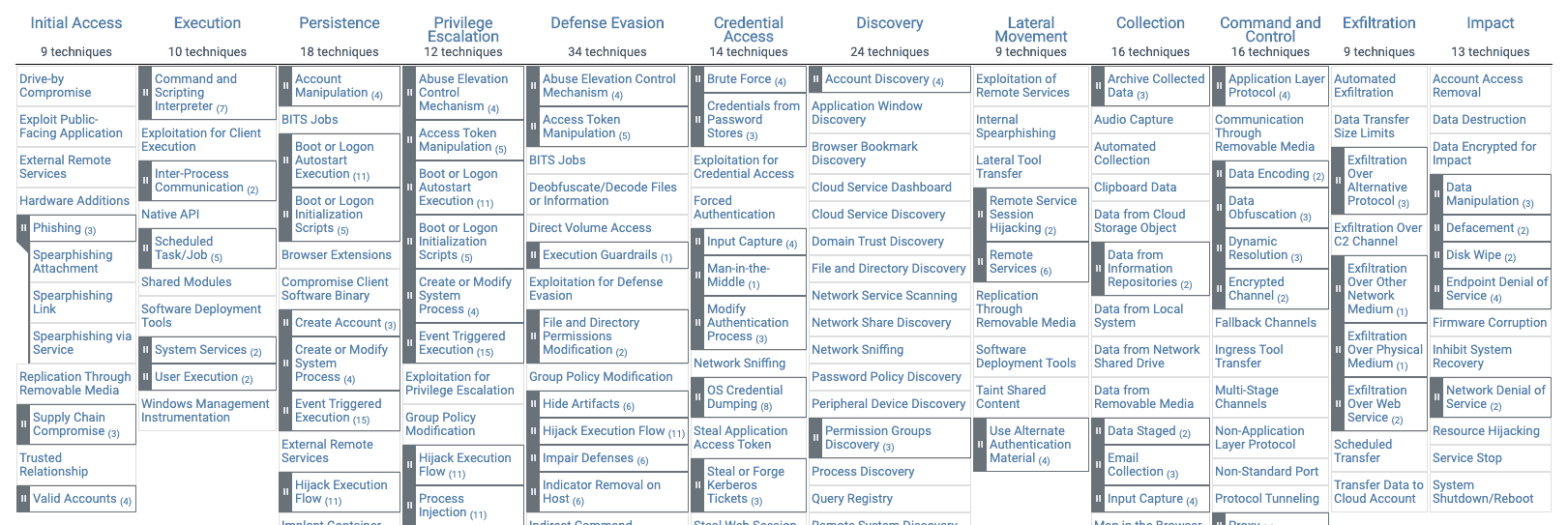
In this matrix there are all the phases of an attack sequence. It is organized so that the tactics are ordered from right to left according to the attack sequence. Under each tactic the corresponding techniques, some of which contain sub-techniques. The two techniques mentioned above are actually sub-techniques of phishing which are part of the first step in the sequence (first column on the left).
Example
It is not necessary for an attacker to use all eleven tactics at the top of the matrix. Rather, the attacker will use the minimum number of tactics to achieve his goal, as it is more efficient and provides less chance of discovery. In this attack (illustrated in the diagram below), the adversary performs initial access to the CEO’s administrative assistant credentials using a Spearphishing link delivered in an email. Once in possession of the administrator’s credentials, the attacker searches for a Remote System Discovery of the Discovery phase.
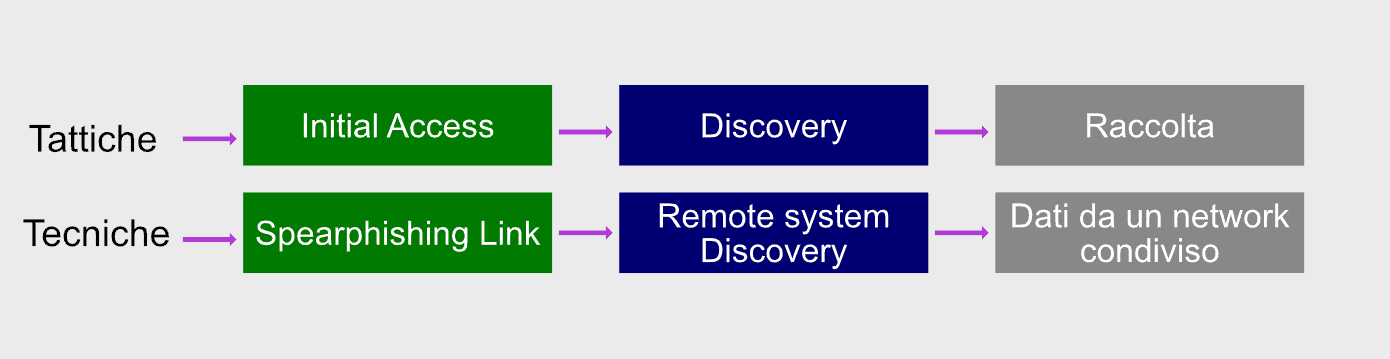
Example: the tactics and techniques used in the phases of an attack
Let’s say they’re looking for sensitive data in a Dropbox folder that the admin also has access to, so there’s no need to increase privileges. The collection, which is the last stage, is done by downloading the files from Dropbox to the attacker’s machine.
Note that if you are using behavior analysis, a security analyst could detect the attack in progress by identifying abnormal user behavior.
And that’s exactly what a SOC should do, here, roughly, how the attack could be mitigated: suppose the administrator clicked a link that no one in the company has ever clicked before, then the administrator logged in a particular Dropbox folder at an unusual time. During the final phase of the attack, the attacker’s computer entered the Dropbox folder for the first time. With behavioral analysis, these activities would be flagged as suspicious user behavior.
To consult ATT&CK
To consult this resource just visit his site and you will find yourself in front of the matrix of which I published a screenshot a little while ago. Suppose we want to consult the Spearphishing Link technique. By clicking on it, the corresponding page will open containing in-depth information about it, such as a description of the technique, what sub-techniques exist, examples of procedures that include it and suggestions for risk mitigation.
Basically all the information necessary to know and defend oneself appropriately from each technique is available.
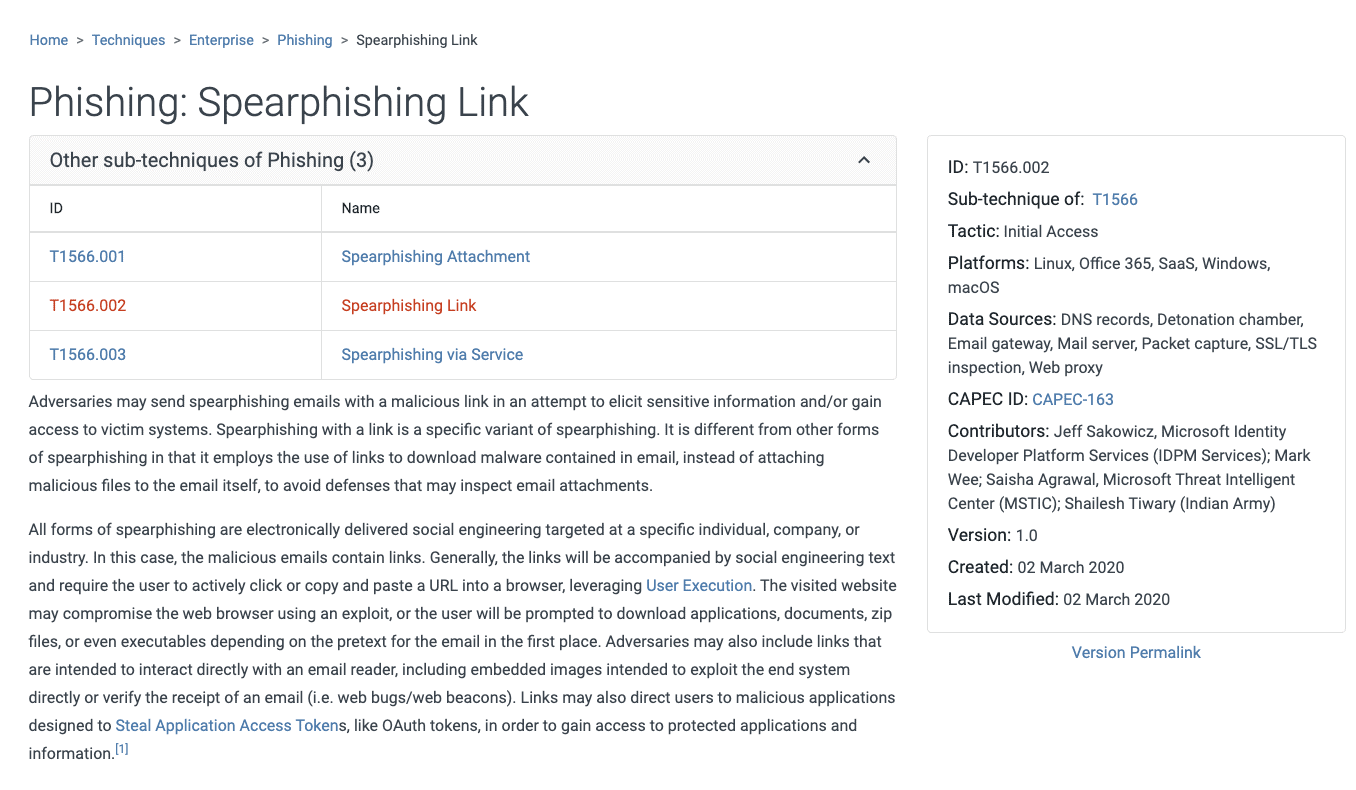
The initial part of the Spearphishing Link data sheet.
Conclusions
The advantages of a resource like MITRE ATT&CK are truly remarkable. Cyber security teams have a valuable ally at their disposal, to which they can add dedicated tools for its consultation.
While it is almost certain that attackers are adapting as defenders deploy new skills, it is also true that ATT&CK provides a way to describe the new techniques they develop.
[btnsx id=”2931″]
Useful links:
Security: Pentest and verification of vulnerabilities
What is a Network Lateral Movement and how to defend yourself
Is SOCaaS useful for your business?
Computer network security: PT vs. VA
Share


RSS
More Articles…
- From Cyberfero to Cyberfero: rebranding of the leading cybersecurity company
- NIS: what it is and how it protects cybersecurity
- Advanced persistent threats (APTs): what they are and how to defend yourself
- Penetration Testing and MFA: A Dual Strategy to Maximize Security
- Penetration Testing: Where to Strike to Protect Your IT Network
- Ransomware: a plague that brings companies and institutions to their knees. Should you pay the ransom? Here is the answer.
- Why IT audit and log management are important for Cybersecurity
- Red Team, Blue Team and Purple Team: what are the differences?
Categories …
- Backup as a Service (18)
- Acronis Cloud Backup (11)
- Veeam Cloud Connect (4)
- Cloud Conference (3)
- Cloud CRM (1)
- Cloud Server/VPS (22)
- Conferenza Cloud (4)
- Cyberfero (15)
- ICT Monitoring (5)
- Log Management (2)
- News (25)
- ownCloud (4)
- Privacy (7)
- Security (203)
- Cyber Threat Intelligence (CTI) (8)
- Deception (4)
- Ethical Phishing (11)
- Netwrix Auditor (2)
- Penetration Test (11)
- Posture Guard (3)
- SOCaaS (65)
- Vulnerabilities (84)
- Web Hosting (15)
Tags
 Unknown Feed
Full Disclosure
- [0day-rubbish] TRENDnet TV-IP302PI firmware 1.02.38 authenticated NTP server-address OS command injection to root command execution via a shell-form system() call (7.2 High, PR:H) October 20, 2026Posted by disclosure via Fulldisclosure on Oct 200day Rubbish Research Team is publicly disclosing a vulnerability in TRENDnet TV-IP302PI firmware 1.02.38, the closed-source IP surveillance camera from TRENDnet (United States). The camera's application daemon is shipped at /hunt/hunt_server: an ARM 32-bit EABI5 version 5TE soft-float binary, dynamically linked against /lib/ld-linux.so.3, 4.5 MB and stripped. Its […]
- [0day-rubbish] Royal Render 9.1.26b: default-unauthenticated job submission on rrServer TCP 7773 reaches worker-side shell execution as the worker identity, measured root (8.1 High) October 20, 2026Posted by disclosure via Fulldisclosure on Oct 200day Rubbish Research Team is publicly disclosing a vulnerability in Royal Render 9.1.26b, the closed-source render-farm job manager for VFX and animation studios from Binary Alchemy (proprietor Holger Schoenberger) of Ludwigsburg, Germany. Royal Render is a different product from the Royal Server gateway sold by Royal Apps GmbH […]
- [0day-rubbish] ProSoft Technology RLX-IFH24E v2.2.44 unsigned firmware upgrade package to root command execution and full account-database overwrite (7.2) October 20, 2026Posted by disclosure via Fulldisclosure on Oct 200day Rubbish Research Team is publicly disclosing a vulnerability in the ProSoft RLX-IFH24E, version v2.2.44, the industrial wireless radio from ProSoft Technology, Inc. (United States). The appliance is a closed-source embedded device and an OEM build of the MicroHard Systems IPx21 platform on the MHX-910 board design: an […]
- [0day-rubbish] Parasoft Continuous Testing Platform 10.7.5-SNAPSHOT anonymous deserialization in the database restore path to JSP command execution as uid=1000 (9.8) October 20, 2026Posted by disclosure via Fulldisclosure on Oct 200day Rubbish Research Team is publicly disclosing a vulnerability in Parasoft Continuous Testing Platform 10.7.5-SNAPSHOT, the closed-source commercial continuous-testing, service-virtualisation and environment-management product from Parasoft, a United States software-testing vendor headquartered in Monrovia, California. The affected component is the em web application inside the vendor's own container image, […]
- [0day-rubbish] Exasol Database 7.1.30 docker-db form: shipped default SYS credential to PYTHON3 UDF os.popen command execution as uid=500(exadefusr), output returned in-band (8.8) October 20, 2026Posted by disclosure via Fulldisclosure on Oct 200day Rubbish Research Team is publicly disclosing a vulnerability in Exasol Database 7.1.30, the in-memory MPP analytical database from Exasol AG (Germany), examined in its docker-db single-container deployment form. The SQL engine is a proprietary C implementation named EXASolution, the server process is exacts, clients speak a proprietary […]
- [0day-rubbish] Edimax BR-6478AC firmware v2.20 authenticated command injection in the setWAN WAN-configuration handler, root command execution (7.2) October 20, 2026Posted by disclosure via Fulldisclosure on Oct 200day Rubbish Research Team is publicly disclosing a vulnerability in the Edimax BR-6478AC, firmware image BR6478AC_v2.20.bin, the dual-band AC1750 SOHO wireless router from Edimax Technology Co., Ltd. (Taiwan). A single authenticated POST that looks like an ordinary WAN settings submission reaches system() with a request-controlled username interpolated unquoted […]
- [0day-rubbish] Edimax BR-6478AC firmware v2.20 authenticated command injection in the formWlanMP manufacturing-test handler, root command execution (7.2) October 20, 2026Posted by disclosure via Fulldisclosure on Oct 200day Rubbish Research Team is publicly disclosing a vulnerability in the Edimax BR-6478AC, firmware image BR6478AC_v2.20.bin, the dual-band AC1750 SOHO wireless router from Edimax Technology Co., Ltd. (Taiwan). A single authenticated POST to a manufacturing radio-calibration route that is still registered in production firmware reaches system() with thirty […]
- [ROOTEDCON] Call for Papers 2027 · RootedCON2027 (Madrid) October 20, 2026Posted by Román Ramírez on Oct 20-=] About RootedCON RootedCON is a technology and cybersecurity conference that will take place in Madrid (Spain) from March 4 to 6, 2027. This will be our XVII EDITION! With an attendance of between 9,000 and 10,000 people, it is the most relevant specialized conference in the country and […]
- VestaCP <= 0.9.8-26: authenticated config-parser eval sinks -> root RCE (VESTACP-2026-001) October 15, 2026Posted by Bryan Ramirez via Fulldisclosure on Oct 15Advisory ID: VESTACP-2026-001 / GHSA-m2mc-xwq7-pw72 Product: Vesta Control Panel (VestaCP) Versions:
- [SYSS-2026-080]: dcm4che - Path Traversal (CWE-22) October 15, 2026Posted by Matthias Deeg via Fulldisclosure on Oct 15Advisory ID: SYSS-2026-080 Product: dcm4che Manufacturer: J4Care Affected Version(s): 5.35.0 Tested Version(s): 5.35.0 Vulnerability Type: Improper Limitation of a Pathname to a Restricted Directory (CWE-22) Risk Level: High Solution Status: Open Manufacturer Notification: 2026-08-06 Public Disclosure: 2026-10-13 CVE Reference: Not yet...
Customers






Twitter FEED
Recent activity
-
SecureOnlineDesktop
Estimated reading time: 6 minutes L'impatto crescente delle minacce informatiche, su sistemi operativi privati op… https://t.co/FimxTS4o9G
-
SecureOnlineDesktop
Estimated reading time: 6 minutes The growing impact of cyber threats, on private or corporate operating systems… https://t.co/y6G6RYA9n1
-
SecureOnlineDesktop
Tempo di lettura stimato: 6 minuti Today we are talking about the CTI update of our services. Data security is… https://t.co/YAZkn7iFqa
-
SecureOnlineDesktop
Estimated reading time: 6 minutes Il tema della sicurezza delle informazioni è di grande attualità in questo peri… https://t.co/tfve5Kzr09
-
SecureOnlineDesktop
Estimated reading time: 6 minutes The issue of information security is very topical in this historical period ch… https://t.co/TP8gvdRcrF
Newsletter
Products and Solutions
Partners
Cloud Models
News
- From Cyberfero to Cyberfero: rebranding of the leading cybersecurity company May 6, 2024
- NIS: what it is and how it protects cybersecurity April 22, 2024
- Advanced persistent threats (APTs): what they are and how to defend yourself April 17, 2024
- Penetration Testing and MFA: A Dual Strategy to Maximize Security April 15, 2024
- Penetration Testing: Where to Strike to Protect Your IT Network March 25, 2024
Google Reviews









Ottima azienda, servizi molto utili, staff qualificato e competente. Raccomandata!read more
Ottimo supportoread more
E'... un piacere poter collaborare con realtà di questo tiporead more
Un ottimo fornitore.
Io personalmente ho parlato con l' Ing. Venuti, valore aggiunto indubbiamente.read more


About
© 2024 Cyberfero s.r.l. All Rights Reserved. Sede Legale: via Statuto 3 - 42121 Reggio Emilia (RE) – PEC [email protected] Cod. fiscale e P.IVA 03058120357 – R.E.A. 356650 Informativa Privacy - Certificazioni ISO